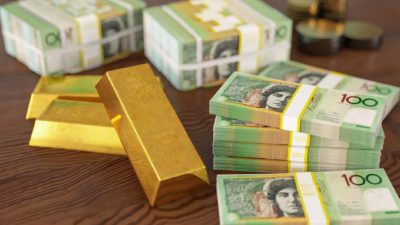
The gold price has fallen from US$5,390 per ounce on 2 March to US$4,477 per ounce today, a decline of 17% since the Iran war began.
Gold is a safe haven that is usually defensive in times of geopolitical upheaval. Yet the gold price has fallen as the war has continued.
In 2025, the gold price surged 65%, and that followed a 24% increase in 2024.
Contrast that with this year, during which the gold price has risen just 4% higher over five months.
Why?
Image source: Getty Images
Gold price was elevated before war began
James Gruber, an Equity Market Strategist at CommSec, says the gold price began surging in 2022, mostly due to central bank buying.
Central banks began diversifying their reserves after the US and allies froze about US$300 billion of Russia's foreign exchange reserves as punishment for invading Ukraine.
In an article, Gruber explained:
This hamstrung Russia's central bank, but it also sent a signal to other countries that their reserves could be frozen at any time.
In other words, their holdings in the likes of US Treasuries were not as safe as previously assumed.
That spurred many central banks to buy large amounts of gold, which was deemed by them to be a safe alternative to holding US-denominated assets.
Demand from central banks was the biggest catalyst pushing the gold price higher.
Once the trend became clear, retail investors joined in.
They bought ASX gold shares, gold ETFs and bullion, and many cashed in their gold jewellery.
Gruber recalled:
You might recall the large lines outside of gold bullion stores in Australia, especially in September and October last year.
That propelled gold prices to reach an intraday record of US$5,589 an ounce in late January.
Since then, and especially after the war began, prices have fallen sharply, albeit there has been a small recovery recently.
Rising demand for gold between 2022 and 2025 also occurred alongside a weakening US dollar, which made gold that much more attractive.
Gruber explains:
In recent years, doubts about the future of the US dollar have arisen with the US running a trade deficit of 6% of GDP and having government debt to GDP of close to 100%, near the highs reached during World War Two.
The current US President, Donald Trump, has further increased the deficit through a combination of tax cuts and higher spending.
What changed after the Iran war began?
Although the gold price has fallen 17% since the war began, the war was not the trigger that disrupted its three-year bull run.
A major sell-off occurred at the very end of January after the gold price ripped nearly 30% in the first month of 2026.
Gruber said central banks may have taken profits after the gold price reached a historical closing high of $5,589 per ounce on 28 January.
Many retail investors also sold their ASX gold shares, ETFs, and bullion during and after that dramatic sell-off.
Then the war began on 28 February.
Sprott Managing Partner, Paul Wong, said the war sparked a rush to liquidity and forced deleveraging for investors.
He argues this does not diminish gold's new role as a strategic asset in the long term.
Gruber notes that the weakened US dollar gained a bit of ground after the war began. This further dampened demand for gold.
Gold is globally quoted in US dollars so when the dollar strengthens, gold becomes more expensive in other currencies, which can result in demand softening, and prices to fall.
This hints at another potential reason for gold's recent plunge. That is, rising real yields.
When real yields (bond yields minus inflation) rise, it makes no yielding assets like gold less attractive.
Rising bond yields
James Gerrish and Shawn Hickman from Market Matters discussed how rising bond yields were weighing on gold in a recent webinar.
Hickman said:
If you can get 5% in the bank with no risk, gold's got to outperform that.
And gold is moving directly with or against bonds. So, as bond [prices] fall, gold's falling.
When US bond yields go up, it weighs on gold.
Bond yields rise when bond prices fall because the interest those bonds pay becomes a larger percentage of their market price.
For example, if a bond that costs $1,000 pays $50 a year in interest, the yield is 5%.
If the bond price falls to $900, that $50 annual interest payment now equals a yield of 5.56%.
The analysts noted that the crowded trade in ASX gold shares had unwound somewhat this year, given the stalled gold price.
Hickman said:
… because we've had so many people overweight the sector. People are holding gold. They haven't got out.
In a lot of cases, you're seeing a bit of a exaggeration move in that regard.
Other factors weighing on demand for gold
As we recently reported, higher interest rates in Australia have pushed everyday savings account rates to 5.5% or higher.
Given that gold is a non-yielding asset, higher interest rates tend to be a headwind for the yellow metal.
The ongoing oil shock is creating resurgent inflation in many nations, including Australia, which means interest rates may rise further.
This may further dampen investor appetite for gold in the short to medium term.
Meanwhile, the US and Iran are reportedly close to a deal that would end the war and reopen the Strait of Hormuz.
The Strait, through which about 20% of the world's oil and gas supply is shipped, has been effectively at a standstill since early March.
Wong points out that Gulf Cooperation Council nations are some of the world's largest accumulators of reserves.
Their gold purchases are funded mainly by oil exports, which have been stalled due to the effective closure of the Strait.
That means many Middle Eastern nations have not had the revenue to continue buying gold.
Wong said the gold price "does not require outright selling to fall; the loss of incremental buying pressure is sufficient".
He also pointed out that the war led to an aggressive investment capital rotation out of metals and into energy.
This has drawn investment flows away from gold and other metals.
ASX gold shares in 2026
Here is a snapshot of how ASX gold shares have performed in 2026 compared to their rise in 2025.
| ASX gold share | Share price movement in 2026 | Share price movement last year |
| Northern Star Resources Ltd (ASX: NST) | -14% | 73% |
| Newmont Corporation CDI (ASX: NEM) | -0.5% | 152% |
| Evolution Mining Ltd (ASX: EVN) | -3% | 164% |
| Perseus Mining Ltd (ASX: PRU) | -10% | 121% |
| Genesis Minerals Ltd (ASX: GMD) | -21% | 194% |
| Regis Resources Ltd (ASX: RRL) | -18% | 196% |
| Resolute Mining Ltd (ASX: RSG) | -4% | 206% |
| Pantoro Gold Ltd (ASX: PNR) | -43% | 220% |