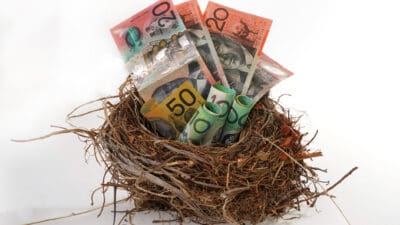
Your superannuation is more than just a nest egg for retirement, it can also be a fantastic tool to generate a consistent passive income for when you stop working.
But how much passive income could a $900,000 balance actually generate each month?
Let's take a look.

Image source: Getty Images
What passive income can I earn off my $900,000 superannuation balance?
To calculate your potential passive income, you simply need to multiply your total superannuation balance by the overall dividend yield of your portfolio.
But the catch is that the answer varies widely depending on what dividend yield you pick.
For example, $900,000 x 3% = $27,000 per year in dividend payments.
But if your portfolio has a slightly higher dividend yield of around 4%, your passive income will be higher. That's because $900,000 x 4% = $36,000 per year in dividend payments.
If your superannuation portfolio yields closer to 5%, you could earn $45,000 every year in dividend payments off the same superannuation balance ($900,000 x 5% = $45,000).
At a 6% yield, you could earn an annual passive income of around $54,000, and at 7%, it could be even higher, at around $63,000.
And so on…
As your dividend yield increases, the passive income you can earn from your $900,000 superannuation balance also increases.
These figures are based on cash dividends before any tax or franking credit benefits.
I want to earn around $45,000 per year in passive income off my superannuation. What ASX shares should I invest in?
To earn around $45,000 per year in passive income from a $900,000 superannuation balance, you'd need a portfolio yielding around 5%. There is a large range of good-quality ASX shares around this level.
Here are some of my top picks.
Transurban Group (ASX: TCL), Origin Energy Ltd (ASX: ORG), Woodside Energy Group Ltd (ASX: WDS) and Harvey Norman Holdings Ltd (ASX: HVN) are all good-quality ASX shares which yield around 5% at the time of writing.
What are my options if I want to go for an even higher yield around 7% or 8%?
Again, there are several options, but you need to be aware that higher yielding ASX shares are generally associated with higher risk.
But the good news is that your passive income will be higher if you strive for this target. A 7% or 8% yielding superannuation portfolio, around $900,000 in size, can earn between $63,000 and $72,000 in passive income over the course of a year.
There are still some good options to consider too. WAM Leaders (ASX: WLE), Atlas Arteria Ltd (ASX: ALX) and Beach Energy Ltd (ASX: BPT) all yield around the 7% to 8% level at the time of writing.
Diversification is key
If you want a portfolio yielding around 5% or even 7%, it doesn't mean that every investment in that superannuation portfolio has to yield that level. It can be a combination that yields 5% or 7% overall.
And remember, you don't need to invest the whole sum in one go. Start with a monthly investment and let compounding do some of the hard work for you.
I'd look at splitting my superannuation portfolio into investments across several different yielding assets, preferably across different sectors.
This diversification strategy means that if one asset drops in value, its performance can be offset by other ASX shares, leading to a more consistent overall result.