Who couldn't use $20,000 in passive income a year?
For some investors, that could help smash down the mortgage faster. For others, it might fund Europe trips, long Friday lunches, or provide a means to escape the 9-to-5 grind earlier.
And while generating $20,000 a year in passive income sounds ambitious, it breaks down to roughly $485 a week.
The real question is: how do you actually build an investment portfolio capable of producing that kind of reliable income?
Here is one simple long-term approach.

Image source: Getty Images
Start with the target
If a portfolio delivers an average dividend yield of 5%, generating $20,000 annually would require approximately $400,000 invested.
That number can feel intimidating at first glance.
But the important thing is remembering that passive income portfolios are rarely built overnight. They are built steadily through years of investing, compounding, and reinvesting returns.
The first stage is not about income at all. It is about building capital.
Focus on growth first
One of the biggest mistakes investors make early on with building passive income is chasing high dividend yields too soon. In many cases, growth can be far more powerful than income during the wealth-building phase.
Companies capable of reinvesting profits at high rates of return can compound shareholder wealth much faster than mature income stocks. For example, businesses like Xero Ltd (ASX: XRO) and Pro Medicus Ltd (ASX: PME) may not offer massive dividend yields today, but both have delivered exceptional long-term capital growth.
Broad market ETFs can also play a major role here. Funds such as Vanguard Australian Shares Index ETF (ASX: VAS) and iShares S&P 500 ETF (ASX: IVV) provide diversification while still giving investors exposure to long-term market growth.
At this stage, the goal is simple: grow the portfolio as large as possible.
Let compounding do the heavy lifting
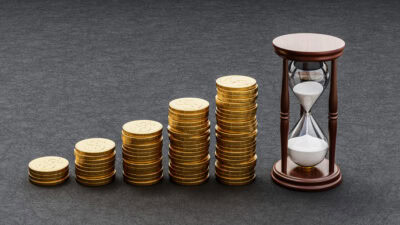
Time is one of the most powerful investing tools available.
If an investor contributed $1,200 per month and achieved an average annual return of 10% over the long term — not guaranteed, but historically achievable — the portfolio could grow surprisingly quickly.
After 10 years, the portfolio would be worth around $250,000. After 15 years, it could approach $500,000.
Importantly, total contributions over 15 years would only amount to about $216,000, with the remainder coming from investment growth and compounding returns.
That is where the real snowball effect begins.
Transition toward income
Once the portfolio approaches the target size, investors can gradually shift toward more income-focused assets.
That could include dividend shares such as APA Group (ASX: APA), Transurban Group (ASX: TCL), or Telstra Group Ltd (ASX: TLS). Income-focused ETFs such as Vanguard Australian Shares High Yield ETF (ASX: VHY) may also help diversify the income stream.
At an average portfolio yield of 5%, a $400,000 portfolio could generate approximately $20,000 annually in passive income.
And if dividends continue growing over time, that income stream could become even larger.
Foolish takeaway
Passive income is rarely created in one giant leap. It is usually built in stages: first by growing capital, then by converting that capital into reliable income-producing assets.
It takes patience, consistency, and time, but for long-term ASX investors, the rewards can be substantial.