Image source: Getty Images
The Nvidia Corp (NASDAQ: NVDA) thing?
You probably don't know what I'm talking about, or you do and don't care.
Or, if you're a shareholder, you care… a lot.
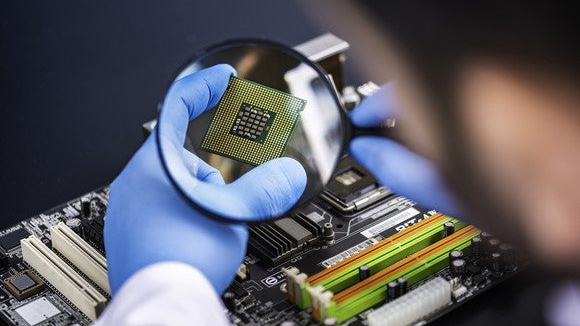
In case you've missed the blanket coverage, Nvidia is the world's largest computer chip maker, whose products are powering the vast bulk of the AI revolution.
And are in such high demand, they sell with around 75% gross margins – that is, about 4 times what they cost to make! Those are unheard-of margins for a manufacturing business, and underscore both the company's technical leadership and the fact that demand is running far faster than supply, meaning Nvidia can essentially set almost whatever price it wants.
And the 'thing'?
The company's CEO and co-founder, Jensen Huang, resigned from both his management and board roles overnight, after somewhere between one and three alleged affairs, including one with a woman alleged to be a Chinese spy, and another who was an employee at the company.
Allegedly. (Because, lawyers.)
Anyway, as a result, Nvidia's shares fell 4.3% overnight.
That's actually not that much, in percentage terms, but two things bear mentioning. First, this is a $5.9 trillion company, so 4.3% is still a lot of money. And second, that extends the company's total share price fall to over 30% since its highs in early October.
(The daily fall was more than 12% when shares first traded, overnight our time. The panic subsided as the night went on.)
The 'so what'?
Well, no-one knows, which is why the shares were volatile.
But let's get one thing out of the way first: the story is blowing up mostly because 'CEO has affair… with pictures' is heaven for subeditors chasing clicks.
Yes, we all say we read the financial press for the serious stories, but… the newspapers aren't silly. As I wrote the other day, it's the old 'I buy Playboy for the articles' thing.
So they'll cover this thing from as many angles as they can until the clicks stop clicking.
There are two significant angles, though. The first does include both corporate- and national security, if indeed one of the women he allegedly had an affair with does have ties to the Chinese national security establishment.
The second is what happens to Nvidia from here. As the old aphorism goes, cemeteries are full of indispensable people.
In other words? In other words, we find ways to move on, after presumably irreplaceable people are… replaced.
But not always to the same degree. Or at all, in other cases.
For example, Starbucks CEO Howard Schultz returned to the role twice, after retiring, the board believing that his specific skills and experience were needed, each time.
Was he irreplaceable? Not entirely, but the board (and shareholders) seemed to think that the company needed him, specifically, rather than someone else.
But what about Nvidia? The company has certainly been lucky – it was able to ride three consecutive waves: computer gaming, Bitcoin (CRYPTO: BTC) mining, and now artificial intelligence.
Was it just luck, though? No, I don't think so. Other companies could and should have muscled in on any or all of those trends, but were unable to do so, successfully.
The question, now, is how vital Huang was to that journey and – far more critically – to what Nvidia might (or not) do next.
Steve Jobs was fired from Apple. Then brought back as the potential (and eventual) saviour of the company. But then he successfully handed over to Tim Cook. The key? Jobs had created the platform… Cook just needed to execute on the culture, brand, capability and ethos of the business he assumed control of. And he did.
So, is Nvidia the 2026 version of Apple? Or Starbucks?
That's the question on investors' minds.
And for the rest of us? It highlights beautifully what we call 'key person risk'.
With all due respect to the CEOs of Woolworths Group Ltd (ASX: WOW) and Coles Group Ltd (ASX: COL), there are plenty of people who could do a good or great job of running those two companies. They are established businesses that need smart strategies and strong execution – but they don't need innovators or people with Steve Jobs' famous 'reality distortion field'.
Those two companies also don't have products that are at constant risk of being consigned to obsolescence by someone else's discovery or invention, either.
As an investor, you need to know the companies you own, the products or services they provide, and the importance of the people at the helm.
Because here's the other thing: Woolies and Coles don't have significant key person risk, but they also don't have significant 'upside potential': strong likelihood of future growth. Often, it's the 'key person' who brings that to the table.
So you can avoid 'key person risk', and that might reduce the potential downside of an investment – but that likely rules out whole swathes of companies that also have significant potential 'key person return' growth ahead.
Did I mention it's hard?
Because here's the (hypothetical) amoral question for shareholders: are you better off with a flawed but valuable CEO in the role, or a less-flawed (none of us are perfect) CEO who will create less value?
And before you say 'well, he's (allegedly) shown himself to be below the standard required', ask yourself who else might be below that standard, and we just don't know.
Or, asked differently: How much value did he create while engaging in some of those alleged activities? How much would have been foregone, if it was discovered earlier? He was every bit as (allegedly) 'wrong' then, too.
For what it's worth, I do think there's some pretty public moralising in this. I'm not religious, but it's interesting what 'sins' we demand punishment for.
No, I'm not condoning his, or any, behaviour. I'm simply asking, as an investor, whether we're letting known, public, imperfections impact us in a disproportionate way, compared to unknown, private imperfections?
And, crucially, whether or not those imperfections make the person in question less valuable than the person who might replace them in the role.
Some of you are nodding, right now. Some are quietly fuming. That's okay. My aim isn't to defend or prosecute Huang, but rather to propose some questions that might help us think, more broadly, about the key people at our companies, as well as the role of public reaction and media reporting, in how we think about these things.
Maybe Huang should go. Or not. Maybe in a similar situation, we might think differently about a different executive.
And we might think about what 'sins' we demand punishment for: we shouldn't let the absence of knowledge about a CEO's shortcomings fool us into thinking they have none!
Lastly, as investors, the job is to think through our portfolio allocations, accordingly. Some people will want no 'key person risk'. Some will be happy with a little, where the upside potential justifies it. And others will happily take it in many companies, theorising that even if the occasional risk comes to bear, the returns from those other companies might well and truly cover that downside.
There is no perfect answer. But we can prepare by knowing ourselves, knowing our preferred approach, and making sure our portfolios represent that understanding.
Fool on!