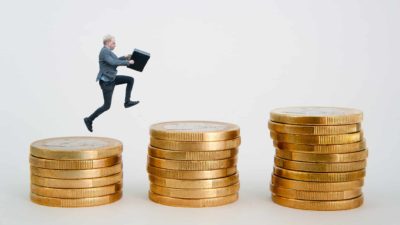
Imagine waking up each morning knowing your money is quietly working for you, generating income, building wealth, and compounding behind the scenes. That's the power of turning capital into cash flow, and it doesn't take millions to get started.
Even a $20,000 investment can become the foundation of a portfolio that pays you regular income and grows in value over time if you use it the right way.
Here's how to start building your own cash flow machine on the ASX.
Image source: Getty Images
Think long-term
The goal isn't to double your money overnight. It is to create an investment that produces reliable, recurring income. This is the kind that can be reinvested now and spent later.
This means focusing on ASX shares that generate consistent profits and share those earnings with investors through dividends or distributions.
Cash flow investing isn't about chasing the highest dividend yield, it is about owning quality income streams that grow sustainably.
Build a diversified foundation
With $20,000, it is tempting to pour it all into one or two ASX bank shares. But diversification is your best protection against setbacks.
For a simple approach, you could look at an income-focused ASX ETF such as the Vanguard Australian Shares High Yield ETF (ASX: VHY), which targets top dividend-paying shares like the big banks, mining giants, Wesfarmers Ltd (ASX: WES), and Telstra Group Ltd (ASX: TLS).
This spreads your income across multiple sectors and geographies, balancing growth potential with resilience.
Reinvest to accelerate your returns
When dividends hit your account, it can be tempting to pocket them. But in the early stages, reinvesting is the smarter play.
Each reinvested dollar buys more income-producing units or shares, which in turn generate more dividends next time around. This creates a compounding snowball effect and can dramatically increase your income.
Add new capital when possible
Once your initial $20,000 is invested, don't stop there. Set up a plan to add small amounts, even $200 to $500 a month, into the same holdings.
Regular contributions build momentum and help smooth out your entry prices over time. You will buy more units when markets are weak and fewer when prices rise, naturally averaging your cost base. This is called dollar-cost averaging.
For example, a starter investment of $20,000 and then $500 a month would turn into $175,000 in 15 years if you achieved an average 10% per annum return and reinvested any dividends.
Keep going for a total of 25 years and you are looking at a portfolio valued at $800,000.
This would give you significant firepower when it comes to generating cash flow from the share market.
In fact, a 5% dividend yield on an $800,000 ASX share portfolio would mean $40,000 in passive income each year.
Foolish takeaway
Turning $20,000 into a cash flow machine isn't about luck or speculation. It is about putting your money into dependable, income-producing assets, reinvesting consistently, and letting time and compounding do the hard work.
It might start small, but with patience and consistency, that steady stream of dividends and distributions could one day turn into a river of passive income.