This article was originally published on Fool.com. All figures quoted in US dollars unless otherwise stated.
Key Points
- Nvidia has agreed to supply up to 10 gigawatts of infrastructure to power OpenAI's next wave of technology buildouts.
- This deal reinforces Nvidia's leadership position in the GPU realm, despite intensifying competition from AMD and custom silicon developers.
- Given OpenAI's aggressive growth prospects over the next several years, this deal provides Nvidia a chance to capture significant incremental revenue -- further fueling its already historic valuation.
Few companies in history have reshaped industries as profoundly as Nvidia (NASDAQ: NVDA). A company that began as a niche designer of graphics chips for video games has evolved into the undisputed leader of the artificial intelligence (AI) revolution. Today, Nvidia isn't just a chip company -- it's the bellwether investors use to gauge the direction that the computing sector is headed.
Nvidia's share price moves on practically every headline tied to AI infrastructure, as its GPUs are powering a growing universe of generative AI applications across the globe. It's no wonder that over the past three years, Nvidia's meteoric rise has catapulted the company into the position of the most valuable business in the world as measured by market cap.
Now, Nvidia is doubling down. Fresh off a $5 billion strategic investment in Intel, Nvidia just opened up its pocketbook again -- this time committing up to $100 billion in ChatGPT developer OpenAI.
The question investors may be asking now is whether these aggressive moves could be the catalysts that propel Nvidia toward even greater milestones, potentially positioning it for another historic run upward -- this time, toward a $10 trillion valuation.
Why Nvidia's partnership with OpenAI matters
On Sept. 22, Nvidia announced a letter of intent to supply 10 gigawatts of computing infrastructure to power OpenAI's next generation of models as the company pursues "superintelligence." Put simply, OpenAI requires unprecedented quantities of GPU clusters to train and scale its large language models -- and Nvidia has both the hardware and software that is needed.
Building a moat against AMD and hyperscalers
While Nvidia still has first-mover advantages in the GPU market, competition in that area has steadily intensified. Advanced Micro Devices offers lower-cost alternatives, while hyperscalers such as Microsoft, Alphabet, Amazon, and Meta Platforms are investing heavily in designing their own custom AI accelerator chips. Yet the OpenAI deal illustrates how Nvidia's competitive moat continues to expand despite these pressures.
The deal underscores Nvidia's dominance in AI infrastructure -- securing long-term demand, revenue visibility, and ecosystem lock-in. By aligning itself closely with OpenAI, Nvidia further embeds itself at the center of generative AI adoption.
In many ways, the agreement functions like a form of vertical integration -- ensuring that OpenAI's most advanced models continue to be built upon and optimized for Nvidia's platform well into the future.
The path to a $10 trillion valuation
Because it's a private company, it's difficult to peg the true value of OpenAI. Media reports suggest it could generate around $20 billion in annual recurring revenue by December -- with projections as high as $125 billion by 2029.
Sustaining that type of growth is ambitious, especially given rising competition from Perplexity, Anthropic, xAI, and Gemini. Moreover, achieving these targets will require astronomical expansions in its processing power -- hence the rationale behind OpenAI's deepening alliance with Nvidia.
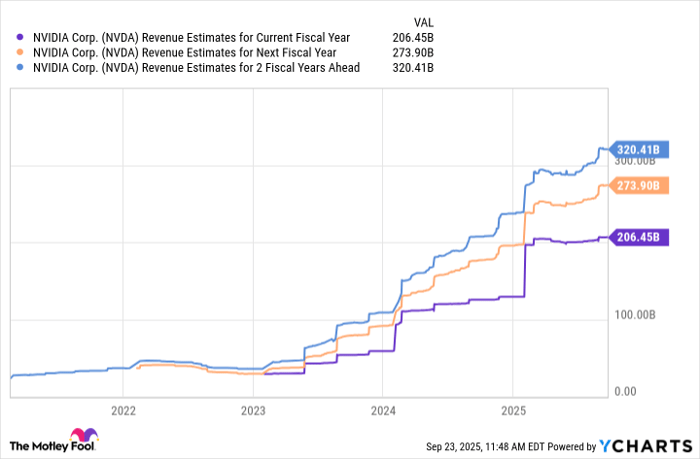
NVDA Revenue Estimates for Current Fiscal Year data by YCharts.
Wall Street currently expects Nvidia to generate $320 billion in annual revenues in 2027. Yet with the Intel and OpenAI deals in hand, that forecast already looks outdated. If Nvidia were to capture even 30% of OpenAI's projected annual recurring revenue, it could add nearly $40 billion of incremental revenue annually.
Perhaps even more significant than the figures above is the underlying signal of these deals: By committing its next-generation systems to Nvidia's backbone, OpenAI -- one of the most influential brands in the AI arena -- is effectively telling the market that Nvidia remains the gold standard for advanced computing. This endorsement is likely to echo across enterprises, cloud providers, and even government agencies, reinforcing Nvidia's platform as the default choice for AI infrastructure.
This halo effect could push Nvidia's revenues far beyond the current analyst consensus, potentially into the neighborhood of $500 billion by 2030. Applying its three-year average price-to-sales ratio of 28 to that figure implies that by that year, its market cap could be well north of $10 trillion.
Ultimately, precise time frames and dollar figures matter less than the broader takeaway: Nvidia stock continues to look like a durable, profitable, long-term holding for investors seeking exposure to the AI megatrend.
This article was originally published on Fool.com. All figures quoted in US dollars unless otherwise stated.