The last two years have shown why it can be an unnerving experience to decide when to buy ASX shares.
When markets are volatile, you worry whether your new investment will sink immediately. When markets are bullish, you fear paying too much for your stocks.
Add to that anxiety of rising interest rates and rampant inflation, and it's a wonder any investor can break out of paralysis.
Betashares assistant portfolio manager Luke Sheather acknowledged this anxiety in uncertain times.
"Nagging questions can undermine confidence and cause even experienced investors to second guess their investment decisions," Sheather said in a recent blog post.
"But perhaps the better question is, to what benefit?"
If one is concerned about investing all their money in at once, a popular alternative strategy is dollar-cost averaging. This is the practice of investing small amounts at regular intervals, in order to "average out" market volatility.
But is that actually effective?

Image source: Getty Images
Compare 5 investors
To settle this question, Sheather's team thus analysed the performance of investors who bought their ASX shares at different times, to see which would come out on top.
Let's consider five different investors who put in $2,000 each year from 2001 to 2022.
Here are the strategies each took:
A. Perfect timing: This investor somehow managed to invest at the share market's lowest point in each year
B. Invest immediately: This investor couldn't be bothered following the market, so bought in on the first trading day of each year
C. Dollar-cost averaging: This investor was fearful of incorrect timing, so divided up her $2,000 into 12 instalments and invested them at the start of each month
D. Bad timing: This investor was racked by bad luck and managed to invest all $2,000 at the peak of the market each and every year
E. Never invest: This investor always made excuses for not entering the market, and never did
This is how each of these strategies worked out:
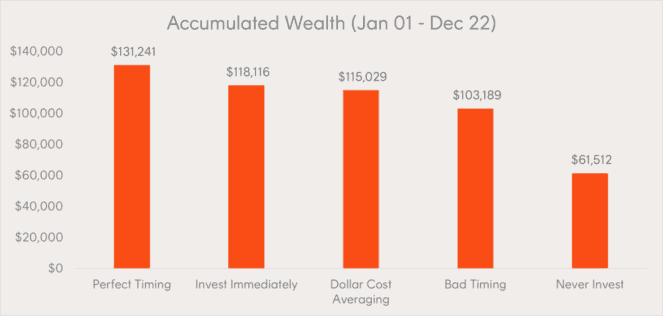
It is no shock that the perfect timer came out on top.
Quite aside from the fact that this is impossible to achieve in real life, there was another eye-opener about the performance.
"What was surprising was his somewhat slender winning margin of just $13,125 ahead of [person B], who had simply invested as soon as she could, without any consideration of market timing."
The other notable is that dollar-cost averaging convincingly lost against simply fully investing whenever the funds are available.
Sheather said that this can be partly attributed to "the tendency for share markets to trend upwards over the long-term".
"This means [person C], who opted not to invest all his money at the start of the period, would more likely be hurt by 'up periods' in the sharemarket than benefit from 'down periods'."
The same conclusion was also shown in recent Morgan Stanley (NYSE: MS) research as well.
"Lump-sum investing may generate slightly higher annualised returns than dollar-cost averaging as a general rule," said portfolio manager Dan Hunt.
Don't worry about the market. Invest it all immediately
What's the moral of the story?
Stop procrastinating and trying to time the market. Just invest whatever you have right now.
"The benefits of market timing may not be worth the effort or attention," said Sheather.
"Investors can, in fact, be better served with a considered and structured investment plan that they stick to, regardless of whether the sharemarket is high or low."
And dollar-cost averaging might make you feel better psychologically, but in the end you're giving up potential returns for that comfort.
"DCA may still be an appropriate strategy for an investor who is anxious about investing all their cash in one go, or who is prone to regret when the market falls suddenly following an investment.
"DCA, like the 'invest immediately' strategy, also eliminates the temptation of market timing and discourages procrastination."
And not investing in ASX shares at all? Forget about it.
Person E was 40% down on even the investor who had the rough luck of investing at the top of the market each year. Doing something is better than nothing.