Rio Tinto Ltd (ASX: RIO) is one of the ASX's biggest companies, commanding a market capitalisation of more than $40 billion.
It's also among the bourse's oldest participants. It was founded in 1873 and has grown to become an icon in Aussie iron ore mining.
These days, the S&P/ASX 200 Index (ASX: XJO) giant appears to be shifting its focus towards critical materials, leaning into aluminium, copper, and lithium, while vowing to reach net zero by 2050.
But is the increasingly future-facing miner a stock worth buying right now?
We posed this question to two of our team, each with opposing opinions on Rio Tinto shares. Here's what they had to say.
Image source: Getty Images
More than a one-trick pony
By Tristan Harrison: The Rio Tinto share price has dropped 9.4% from 19 April 2023 and was trading at $111.59 at yesterday's close, so it's now noticeably cheaper. Certainly, the price of iron ore has declined, but I think it's only going to drop so far before high-cost iron ore producers step back from production. This should support the iron ore price.
Even at an iron ore price level of US$100 per tonne, Rio Tinto can pay large dividends. According to Commsec, the company could pay a grossed-up dividend yield of 9.8% in FY23 and 9.2% in FY24. That alone could mean good returns.
However, what I'm most excited about with Rio Tinto is its increasing exposure to copper. While it's already making earnings from copper, the company has a major production boost in the works, which isn't reflected in its current earnings.
Rio Tino has 66% ownership of the large Oyu Tolgoi copper project in Mongolia. The company is working with its joint venture partner, the Mongolian government, to progress this.
As well, Rio Tinto says the energy transition could add as much as 25% to demand across its key products by 2035. Copper and lithium (which it's also investing in) are enabling good diversification of its earnings away from selling iron ore to China.
The ASX mining share is also involved with the La Granja copper project in Peru, one of the largest undeveloped copper deposits in the world. It sold a 55% stake in the project but still has a sizeable interest.
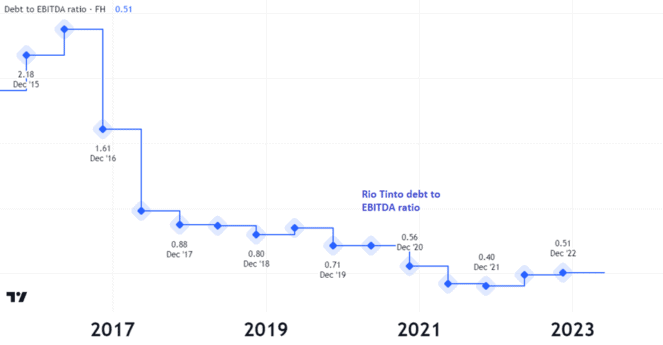
The final thing I'll mention is that Rio Tinto is entering this period of investment with a good balance sheet, as we can see in the chart below. Its debt to earnings before interest, tax, depreciation and amortisation (EBITDA) is healthy compared to most prior years.
Why I'm not digging Rio Tinto shares right now
By Brooke Cooper: There are plenty of things to like about Rio Tinto shares – notably their dividends. However, I'm not in the market for the mining giant's stock right now for a few key reasons.
The first is timing.
The iron ore giant, and its peers, are typically cyclical shares. That means its earnings will ebb and flow on factors it can't control, like commodity prices.
Take the iron ore price, for instance. It roared to a record high of more than US$200 a tonne in 2021. Today, it's sitting closer to US$100 a tonne – with some experts tipping it to continue falling in the medium term.
Thus, I think the best time to buy Rio Tinto shares is still to come.
But there's plenty more to the ASX 200 company's business model than iron ore. On that note, we come to its lithium leg.
Rio Tinto owns two major lithium projects: Argentina's Rincon lithium project and Serbia's Jadar lithium-borate project. Broker UBS is said to have dubbed both projects "high-risk", my Fool colleague Bernd reported last month.
Rincon, an undeveloped lithium brine project, was snapped up by Rio Tinto in an $825 million acquisition last year. Meanwhile, the Serbian government has blocked the development of the Jadar project. The company remains hopeful it can get the $2.4 billion project off the ground in the future.
Turning to copper exposure. For this commodity, I personally think BHP Group Ltd (ASX: BHP) could be a better buy.
Just take a look at the below comparison of the commodities from which BHP realises its underlying earnings before interest, tax, depreciation, and amortisation (EBITDA) against those of Rio Tinto (all in USD and approximate), as per their latest full-year reports.
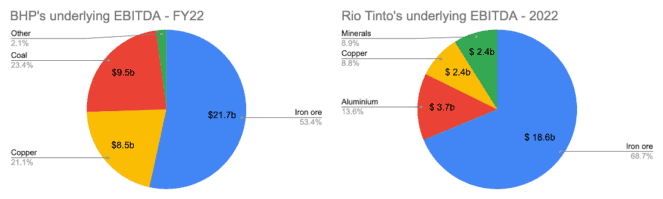
Of course, as Rio Tinto and BHP don't report in the same 12-month period, the above figures likely also depict variances in commodity prices, but the point remains.
With all that considered, I'm not in the market for Rio Tinto shares right now. Though, I admit the ASX blue chip could be a future contender for my portfolio.