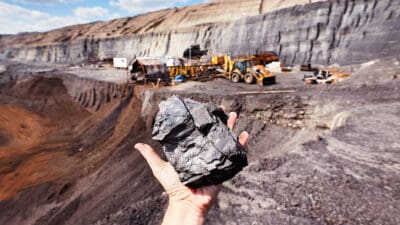
The Lynas Rare Earths Ltd (ASX: LYC) share price has been dragged from pillar to post during the last 12 months.
Under the pressure of tumbling rare earth element prices, Lynas shares have cascaded a stomach-turning 30% in the space of a single year, as shown below. The rocky road hasn't smoothed this year either, as prices of neodymium and praseodymium have been squashed by another 27% and 22% respectively.
I purchased my first parcel of Lynas shares nearly four years ago and doubled down soon thereafter following a 17% fall in the price.
Still up 135%, could it be time to take my gains and run for the hills? After all, a falling commodity price means reduced profits; and Tesla Inc (NASDAQ: TSLA) is planning to do away with rare earth elements (REE) altogether — right?
The original growth story for Lynas shares
Admittedly, as a massive supporter of electric vehicle (EV) adoption, my interest in Lynas originally stemmed from discovering the demand for REE created by the electrification movement.
Not long after doing some digging, it quickly became clear that more of this peculiar magnetic material would be needed if the planet were to shift to cleaner energy technologies and their electric-powered counterparts — a lot more.
According to data from the International Energy Agency, the amount of REE required for clean energy technologies could increase by between three to seven times by 2040 compared to 2020, pictured below. A boom in wind power and EVs having being earmarked as potential lead drivers of this drastic increase.

At the same time, tears in the geopolitical fabric connecting China and the Western world were already beginning to form back in 2019. The trade war between the United States and the People's Republic was in full swing by midyear, bringing attention to an uncomfortable reliance on China-produced and refined rare earths.
Back then, China was responsible for 60% of all rare earths produced and a staggering 87% of all refined REE, as depicted below.

Those figures may have changed slightly since then, but our dependence on an increasingly doubtful trade partner for a material growing in importance has spurred forth a demand for sources outside of China.
What made Lynas shares appealing to me was its position as the world's largest rare earths supplier outside of China. In addition to this, supplying a critical material that is projected to enjoy a structural tailwind for a decade or more sounded like a recipe for success at the right price.
It was fun while it lasted
On 1 March, Tesla held an investor day and pitched its big plan to remove all rare earths from its next generation of electric motors.
In true reactionary fashion, Lynas shares have fallen roughly 21% since the announcement.

The fear of the world's largest EV maker stripping away its need for Lynas' product has clearly taken its toll on sentiment. However, there are three key reasons why I don't think this move is the nail in the coffin that many are making it out to be.
Firstly, part of the reasoning behind this decision is due to the unpredictable supply of REE. Tesla doesn't want to get caught in the crossfire of another trade war — or any form of war — where its reliance on rare earth supply would act as a bottleneck to future EV deliveries.
However, as Lynas pushes forward with constructing a processing facility in Texas — and another locally in Kalgoorlie — the risk of supply should begin to reduce. Potentially, this could put rare earths back on the table for Tesla given the material's superior characteristics.
Secondly, there's a large and growing market for REE away from EVs. Even if Tesla were to permanently shift away from using rare earths, the softened prices are more likely to attract greater application elsewhere.
Lastly, there are simply no alternatives to rare earths when efficiency, e.g. power to weight ratio, is the priority. These materials emit the strongest magnetic field on a pound-for-pound comparison to other solutions.
Will I be selling?
In my opinion, the need to diversify rare earths sources remains a key issue. Fortunately, Lynas is undertaking this mission by developing processing facilities in Australia and the United States.
I believe the return on capital on these facilities will be substantial over the years to come, proving to be worthwhile investments.
Furthermore, Lynas shares are trading on a price-to-earnings (P/E) ratio of approximately 11 times. Indeed, suppressed REE prices in the near term could push the P/E temporarily higher. Though looking at the opportunity over the next decade, I'd consider it borderline inexpensive.
As a result, I won't be selling my Lynas shares anytime soon.