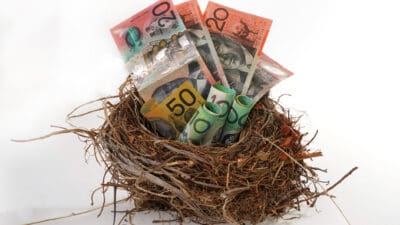
With as little as $25 a week, investors can build enough passive income from ASX shares to generate $104,000 of annual dividends.
Of course, I'm not talking about saving $25 a week for just one year – which amounts to $1,300 – and that would suddenly turn into $104,000 of yearly dividends.
But there are two great reasons why ASX shares can help build that sort of wealth and cash flow.
The first is that we can start investing in ASX shares with a much smaller amount than other asset classes such as property. Many brokers have a minimum brokerage of just $500. We don't need to invest $25 every single week, investors can just build their cash pile towards the next time they're going to invest.
Another great way that ASX shares can help grow wealth is compounding. That's essentially the concept where interest earns interest. The more of the return that comes from compounding, the less we need to add to the portfolio ourselves.

Image source: Getty Images
How to grow a large portfolio
If my crystal ball was working, I'd say it would be good to find the next Pro Medicus Limited (ASX: PME). That's an ASX healthcare technology business that is winning and renewing a number of contracts with large healthcare providers in the US. Plus it has great profit margins and it's growing the dividend at a strong rate.
Since June 2011, the Pro Medicus share price has risen by over 30,000% from when the ASX healthcare company's share price was just 20 cents. The last two declared dividends amount to a fully franked dividend of 25 cents per share, plus the franking credits. That's a strong passive income compared to the original investment.
But, I think a lot of people would do well if they can just get the benefit of compounding. An average annual return of 10%, which is the historical long-term return of the overall ASX, can turn small numbers into much bigger numbers.
After 10 years it grows to $20,700.
In 20 years it reaches $74,400.
After 30 years it can grow to $213,800.
In 40 years it'd reach $575,000.
With a 50-year timeframe, this would grow to $1.51 million.
Strong passive income
With a $1.5 million sized portfolio, investors could target a portfolio dividend yield of around 7% to generate $104,000 of annual passive dividend income with higher-yielders like Metcash Limited (ASX: MTS), Charter Hall Long WALE REIT (ASX: CLW), Shaver Shop Group Ltd (ASX: SSG) and Adairs Ltd (ASX: ADH).
But I don't know what the high-yielders will be in 50 years. And 50 years is a long time to wait. So, there are two options – invest more per week and/or try to earn better investment returns.
Investing more would take more saving.
I don't know what all of the investment returns for every ASX share are going to be in the coming decades.
But, while past performance is not a reliable indicator of future returns, Vaneck Morningstar Wide Moat ETF (ASX: MOAT), which invests in businesses with strong competitive advantages at a good price, has returned an average of around 15.1% per annum over the past five years. I wouldn't bet the house on any investment being able to make that sort of investment return, but it's an example of something that could outperform and then help investors achieve passive income.