Many more people than we think have the capacity to retire as millionaires. Even on a minimal income level, it is entirely possible to achieve millionaire status by retirement age if you start early enough.
You don't need to be a high income earner or ultra wealthy to achieve this goal. A little discipline and a long-term mindset are really all that is required.
How, you ask? Through the magic of compounding returns.

Compounding returns
The trick with compounding returns is to start as early as possible. The longer you let your money compound for, the greater the return. For example, say you start with an investment of $10,000. You invest it and earn a 10% annual return. Then you add $100 each week to your investment.
After 10 years you have $108,812. After 20 years you have $365,105. And after 30 years? $1,029,863. The key, obviously, is consistency and patience.
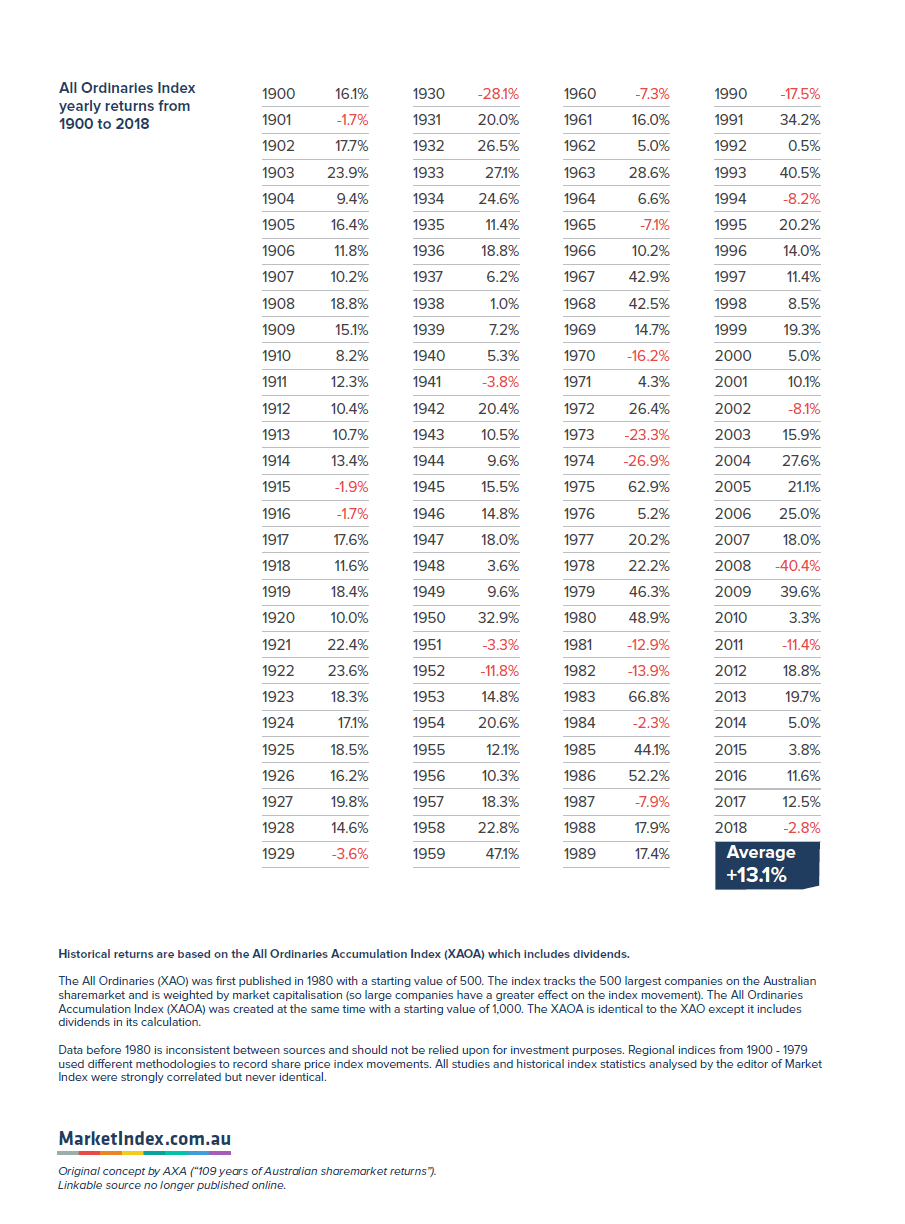
The Australian stock market has historically returned even greater than 10% per annum – over the period between 1900 and 2018, returns averaged 13.1% per annum. Those returns consisted of both dividends and capital gains. If you want to maximise the benefits of compounding returns you are going to need to reinvest your dividends rather than spending them.
Reinvestment
Each dollar of dividends reinvested will grow allowing you to maximise the value of your overall portfolio. Each dollar of dividends spent is gone and cannot contribute to increased future returns. While it may be tempting to spend interest or dividend income in the present, your future self will thank you for putting it aside and letting the power of compounding returns take effect.
The earlier you start investing and the longer your investing time horizon, the greater your opportunity to take advantage of the power of compounding. By starting early you give yourself the advantage of time. Time allows your returns to compound and allows you to ride out volatility in the share market.
Getting started
So, how to get started? Review your budget and see how much you can realistically set aside each week, fortnight, or month. Then, open a high interest savings account. Deposit your selected amount into this account at your chosen interval. Consistency is key here. If for some reason you can't make the deposit one time, make sure to prioritise it next time.
If you decide to invest in the share market, open a low cost brokerage account. Check minimum trade size requirements. Once you have sufficient funds in your high interest savings account, you can transfer them to your brokerage account and get ready to make your first trade.
Investment strategy
If you are building your portfolio from scratch it is important to start from a solid base. It may be tempting to throw all your funds into a "hot tip" but this is a high risk strategy. A more sensible approach is to invest in a variety of shares across a range of industries and sectors. This is called diversification.
Diversification reduces the risk of your overall portfolio by reducing your exposure to one particular asset or risk. That way, if a single company or industry experiences a significant loss, it won't take your portfolio with it. By investing across a range of companies and industries the volatility of returns on your overall portfolio is reduced.
Investment options
It is fairly simple to achieve a diversified portfolio with limited funds using exchange traded funds (ETFs). ETFs are traded on the stock market like shares, but hold an array of assets such as local or international shares providing for instant diversification.
The Betashares Australia 200 ETF (ASX: A200) provides exposure to the largest 200 companies listed on the ASX, based on market capitalisation. Distributions are paid quarterly and management fees are 0.07% per annum.
The fund returned 12.48% in the year to 30 September. Top holdings include Commonwealth Bank of Australia (ASX: CBA), BHP Group Ltd (ASX: BHP), CSL Limited (ASX: CSL), Westpac Banking Corp (ASX: WBC), National Australia Bank Ltd (ASX: NAB), Australia and New Zealand Banking Group (ASX: ANZ), Woolworths Group Ltd (ASX: WOW), and Wesfarmers Ltd (ASX: WES).
The iShares Core S&P/ASX 200 ETF (ASX: IOZ) aims to provide investors with the return of the S&P/ASX200 Accumulation Index before fees and expenses. Distributions are paid quarterly and management fees are 0.09% per annum. The fund returned 13.31% in the year to 30 September. Top holdings are similar to those of the Betashares Australia 200 ETF.
For a different approach, the VanEck Vectors Australian Equal Weight ETF (ASX: MVW) held 85 ASX listed shares as at 31 October and tracks the the MVIS Equal Weight Index (before management costs). The Index is diversified across companies and sectors and includes the largest and most liquid ASX companies. The Fund returned 18.26% in the year the 31 October.
Distributions are paid twice annually and management fees are 0.35% per annum. Top holdings include Iluka Resources Ltd (ASX: ILU), Challenger Ltd (ASX: CGC), Stockland Corporation Ltd (ASX: SGP), Star Entertainment Group Ltd (ASX: SGR), CSL, and Sydney Airport Holdings Pty Ltd. (ASX: SYD).
Foolish takeaway
Attaining millionaire status is not out of reach with the benefit of time and compounding returns. When you take into account the compulsory savings constituted by superannuation you may be further ahead than you first estimated. This makes it even more important to ensure your savings are invested in a way that fits your circumstances and goals.
Between superannuation and voluntary savings, net investments can add up quicker than you expect. The key is consistency, discipline, and the patience to let compounding returns work their magic.