The other week, in my article, "4 Common Mistakes Millennials make Stock Market Investing" I began to answer some of the questions I am frequently asked by my friends as a young investor.
My aim is to one-by-one, discuss these questions, and de-bunk the misconceptions contained in them…
The other week I answered the question, "Aren't shares really risky?". I discussed why I think this belief is a costly mistake. This week I will take a look at another common mistake made by investors.
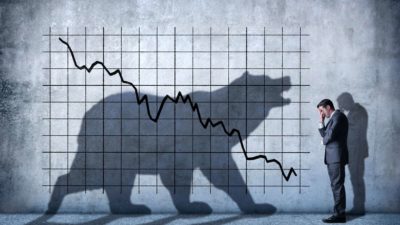
Mistake 2 – "The market's crashing – I've gotta get out!"
This is absolutely a real concern to have. But if you look at what a stock market crash fundamentally is, I think a lot of the fear factor disappears, which will help you to act rationally in times when many others cannot. Let's break down some important characteristics of the stock market for you to keep in mind as we discuss the repercussions of a market crash:
- The stock market is essentially a market place for buyers and sellers to come together and buy a part ownership in real life businesses.
- Stock prices over the long-run reflect the earnings of the underlying business.
- Stock prices over the short-term can fluctuate heavily based on the sentiment and psychology of buyers and sellers in the market. However, over the long-run history tells us, that eventually share prices return to a level that reflects the underlying earnings of the business.
Now keeping these characteristics in mind, lets take a look at what happens during a market crash. I will discuss the different types of market crash and in turn, how an investor can act during a crash to minimise loss of capital.
I believe you can separate the reasons of a market crash into two broad baskets, however usually it is a combination of both:
- Economic downturn
- Sentiment shift
Economic downturn
This is a situation where something has fundamentally gone wrong in the economy and has caused a large number of people to lose their jobs and therefore, their capacity to spend.
Examples of this are The Great Depression, and the 2008 Global Financial Crisis.
When less people have less money to spend then this is not a very rosy back drop for businesses to grow profits. As stock prices over the long-term follow the underlying trajectory of businesses' earnings, you can see how this would not be a good period of time for investing in stocks.
However, the headwinds of investing during an economic downturn are not stock market specific. Property prices will also fall as buyers dry up and owners are forced to sell. Basically there is no easy-out for investors during times like this.
Ways to reduce capital loss during these times are to focus on having exposure to "defensive" or "all-weather" stocks in your portfolio that are not affected as much by a consumer's reduction in wealth.
Examples of these type of companies are health care companies like CSL Limited (ASX: CSL) and Ramsay Health Care Limited Fully Paid Ord. Shrs (ASX: RHC), or a non-discretionary retailer like Woolworths Group Ltd (ASX: WOW). This is because people will feed themselves and look after their health as a priority.
Fortunately, large economic downturns happen very rarely. They are also near impossible to predict. So if you choose not to invest because of the fear of an economic downturn, and you turn out to be wrong, you suffer a huge opportunity cost in all of the gains you have foregone by not being invested during this time.
Sentiment shift
This is a situation when investors have been feeling very optimistic about the returns on offer in the stock market so they continue to invest even as stock valuations become stretched.
Because stock prices can fluctuate around the intrinsic value of a business over the short-term, we can have periods of optimism where stock prices are bid up to extreme valuations. Sometimes this phenomenon is referred to as a 'bubble'.
And as we all know, one day the bubble must pop. There will eventually be a change in sentiment that will bring stock prices back down to true value, or sometimes will they even overshoot in the opposite direction and sentiment will turn negative making stocks undervalued.
This type of market crash is far more common, and is the time where good investors can make a lot of money and bad investors lose a lot.
The reason people lose a lot of money during a crash is because they are psychologically affected by seeing a 'paper loss' in their portfolio. It is not a good feeling to log onto your brokerage account and to see red letters and numbers outlining how much money you have 'lost' in a day, a week, or a year. A poor investor will then panic, and sell all their stocks for low prices.
Meanwhile, smart investors will make money during a downturn because they will be able to withstand their psychological pain, and identify quality businesses that are now on sale at discounted prices.
One way to stay calm during times when you are psychologically feeling the pinch, is to come back to the three characteristics of the stock market that I have outlined. By remembering that prices can fluctuate over the short-term, but will ALWAYS return to a level that reflects the underlying earnings of a business in the long-term, you can sleep easy during turbulent times.
Foolish takeaway
Market crashes are part of the parcel of investing. However, it is not a stock market specific phenomenon.
All investing markets go through ups and downs over the short-term. This includes property too. Property crashes are just not as psychologically damaging because you are not constantly being quoted with an updated price for your investment, like you are in the stock market.
So in the same way as you are unlikely to rush out to sell your house just because the price has dropped by 10%, you should not do this with your shares either. By remembering that your investment in shares is a part-ownership of a real life business, and not just a ticker code, you will be more adept to withstand the psychological pain of a market crash and be able to reap the rewards over the long-run.