Image source: Getty Images
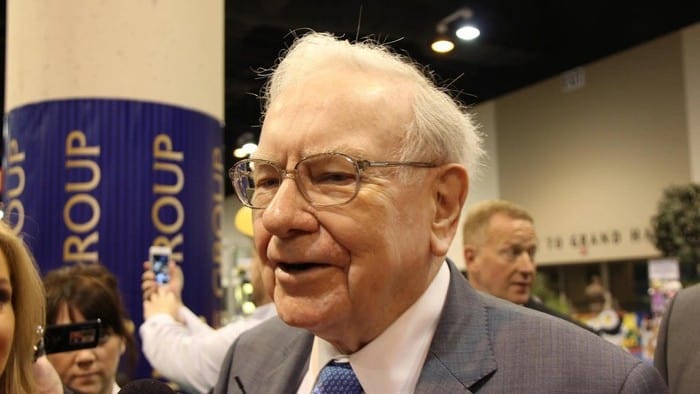
Warren Buffett turns 96 today.
Many of us have referred to him affectionately as "Uncle Warren" for years. Not because we're related, sadly (though I continue to hope that Ancestry.com uncovers an as-yet unknown branch of the Phillips/Buffett family tree!) but because he's probably the closest thing the investing world has to that wise older relative who has been around forever, has seen pretty much everything, and usually has something sensible to say.
(Before you write in, yes his birthday is August 30… but that's 'today' in the US, where he lives!)
Yep, I'm an unabashed Buffett fan.
Not because he's perfect. He isn't. Buffett has made plenty of mistakes, and has spent a fair chunk of his annual letters telling us about them.
But if you were going to choose someone from whom to learn about investing, his record is pretty hard – essentially impossible – to beat.
So, on his birthday, let's do that.
When Buffett took control of Berkshire Hathaway (I own – B class – shares, for the record) in 1965, it was a struggling textile company. What followed was one of the great business and investment stories of all time.
And the numbers are almost silly.
Berkshire compounded at roughly 20% a year for decades. The US sharemarket itself did very well over that time, but Berkshire did much, much better.
The difference between 10% and 20% in any one year doesn't look life-changing.
Give it a few decades, though, and you get a very different answer.
Which, actually, is probably the first Buffett lesson: compounding needs time.
People spend an enormous amount of effort wondering what the sharemarket will do tomorrow, next month or next year. Buffett built his fortune largely by finding good places to put money and then giving them a very long time to work.
One of my favourite Buffett lines is:
"Price is what you pay. Value is what you get."
Learning the difference between those two ideas is vital for investors.
A share price is just the price at which a buyer and seller happen to agree to transact today. It isn't necessarily what the company is worth.
Often the two are reasonably close. Sometimes they're miles apart.
And yet we tend to let the price tell us how we should feel about the investment.
A share price rises 30% and suddenly we're more confident about the company. It falls 30% and we start wondering what we got wrong. (You're nodding along, aren't you?)
Maybe something really has changed. Often, though, it hasn't. It's just the market being its usual emotional, short-term, self.
Buffett has always encouraged investors to turn that thinking around: work out what you think the business is worth, then decide whether the price makes sense.
Which leads to another Buffett favourite:
"Be fearful when others are greedy and greedy when others are fearful."
That… doesn't mean it's easy.
Being greedy when others are fearful sounds terrific when you're sitting comfortably at home and the market is behaving itself. It looks even better in hindsight, when you fantasise about buying those shares during the last crash.
It's harder when shares have fallen 30%, the headlines are full of doom and gloom, economists are predicting recessions, and your brain is telling you that perhaps you should wait until things become clearer.
They will become clearer, of course.
Thing is, shares will probably also be more expensive by then.
You don't get bargain prices and blue-sky headlines.
Buffett also changed as an investor, which I think is an underappreciated part of his story.
His early investing was heavily influenced by Benjamin Graham: buy something very cheap, ideally for less than the value of its assets, and wait.
It worked.
But the late, great, Charlie Munger helped persuade Buffett that there was another way.
As Buffett later put it, "It's far better to buy a wonderful company at a fair price than a fair company at a wonderful price."
That shift helped produce investments such as Coca-Cola and American Express and, eventually, the purchase of entire high-quality businesses.
It's also a useful reminder that even Warren Buffett had to get better at investing.
He changed his mind.
He learned.
He incorporated better ideas when he found them.
Which brings me to another Buffett idea more investors should take seriously: the circle of competence.
You don't have to have a view on everything.
In fact, you really shouldn't.
There are businesses I don't understand well enough to value with any confidence. There are industries whose futures are too uncertain. And there are plenty of things I might understand reasonably well but where I have no particular insight that the market doesn't already have.
That's okay.
To use a baseball metaphor that Buffett has invoked, as an investor you get to choose which pitch you swing at.
There are thousands of listed companies. You don't need to own all of them. You don't need to understand all of them. You certainly don't need to have an opinion on all of them.
And Buffett's preferred holding period?
"Forever."
Yes, he's sold shares, so don't take that absolutely literally.
The point is that when you buy shares in a company, you should be thinking about the business you're becoming a part-owner of, not who might pay you more for the shares next week.
In fact, that's the thread that runs through most of Buffett's best advice.
Shares are businesses.
Price and value aren't the same thing.
Time is your friend.
Temperament matters hugely.
You don't have to swing at every pitch.
And avoiding stupidity can be every bit as valuable as trying to be brilliant.
None of those ideas is particularly complicated.
Maybe that's why people keep looking for something more sophisticated.
But Buffett has spent more than 60 years showing what can happen when some fairly straightforward principles are applied with extraordinary discipline.
No, you won't make 20% annual returns. Me either. There is only one Warren Buffett.
But I reckon we'd all be better investors if we borrowed a little more of his patience, rationality, humility and willingness to think like a business owner.
It's Buffett's birthday, but we get his lifetime of wisdom as our present.
Happy 96th birthday, Uncle Warren.
Fool on!