DroneShield Ltd (ASX: DRO) shares are currently trading around $1.82 after another volatile period for the defence technology company.
Just a week ago, I thought the valuation was starting to look more attractive after recent weakness. Since then, the company has released a trading update and consensus earnings estimates for FY26, FY27, and FY28 have been reduced.
That is disappointing. It suggests DroneShield could take longer than previously expected to turn its rapid revenue growth into meaningful profits.
So, are DroneShield shares now a buy, hold, or sell?

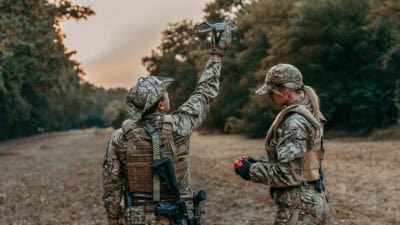
Image source: Getty Images
Consensus cuts raise the bar
DroneShield is growing quickly, but analysts have recently reduced their expectations for its profitability.
According to CommSec, consensus earnings per share estimates now stand at 0.1 cents in FY26, 0.6 cents in FY27, and 1.8 cents in FY28.
At the current share price, the FY28 forecast places DroneShield on a price-to-earnings multiple of roughly 101 times. That is a demanding valuation for a company operating in an industry where contracts can be large and their timing can be difficult to predict.
The forecasts also suggest investors may need to wait several years for the company's revenue growth to translate into meaningful earnings.
DroneShield is investing in manufacturing capacity, product development, sales operations, and the wider infrastructure needed to support its expansion. These investments could help it become a much larger company over time, while requiring patience from shareholders during the current growth phase.
Why I remain positive on DroneShield shares
The company's top-line growth remains impressive.
DroneShield expects first-half revenue of $125.8 million, representing growth of 74% over the prior corresponding period. This shows that rising global concern about drone threats is already producing substantial customer demand.
DroneShield had secured $206 million of committed FY26 revenue by 28 July and expects full-year revenue of between $250 million and $270 million. That would represent growth of between 15% and 25% compared with FY25.
Management is also building recurring revenue through software, subscriptions, warranties, and long-term services. Recurring revenue represented an estimated 11.3% of first-half revenue, giving DroneShield another way to grow as its installed base expands.
I also like the direction of its technology development. The recently unveiled RfAI-3 detection engine is designed to identify drone-related emissions beyond threats that have already been catalogued.
DroneShield expects releases from its next-generation hardware platforms to begin during the second half of 2026 and continue through 2027. This product cycle could support further demand as drone technology and customer requirements evolve.
Counter-drone technology has applications across defence, government, law enforcement, and critical infrastructure. I believe spending in this area could continue increasing as drones become cheaper, more capable, and more widely used.
Foolish takeaway
My verdict on DroneShield shares is a long-term buy.
I would classify it as a higher-risk growth investment that demands patience and could remain volatile.
The valuation leaves limited room for disappointment, but DroneShield is already converting demand into substantial revenue, developing new products, and expanding the recurring component of its business.
At around $1.82, the shares are admittedly less attractive under the revised earnings forecasts. But I still believe the long-term counter-drone opportunity is large enough to justify buying for investors prepared to hold through the company's investment phase.