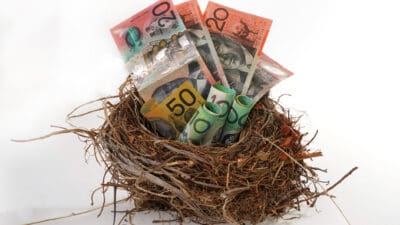
Most Australians hope to retire on autopilot, clocking off at 67 because that is when the Age Pension turns up, not because their superannuation told them to stop. But super runs on its own clock, and it is seven years faster than the pension's.
Once you turn 60 and meet a condition of release, your superannuation balance is yours to draw on. The real question isn't whether you're allowed to retire early. It's whether your portfolio can actually carry you through the years before the Age Pension exists, and comfortably beyond it.

Image source: Getty Images
The seven-year delay
The Association of Superannuation Funds of Australia (ASFA) estimates that a comfortable single retirement needs a balance of around $630,000, generating roughly $54,840 a year. A comfortable couple needs about $730,000, for around $77,375 a year. Modest retirements need far less: $110,000 for a single and $120,000 for a couple.
Those figures assume retirement begins at 67 and the money lasts to around 85. Retire at 60 instead, and there is no Age Pension for seven years. Every dollar of income in that gap has to come from the portfolio alone.
What the portfolio actually needs to do
There are two honest ways to fund that gap. Draw the portfolio down at 5% a year, spending some capital along with the growth. Or aim for a 4% income yield and leave the capital untouched.
For a single retiree chasing $54,840 a year, a 5% drawdown needs a portfolio of roughly $1.1 million. Relying purely on a 4% yield lifts that to around $1.37 million. Couples chasing $77,375 a year need about $1.55 million under the drawdown approach, or close to $1.93 million on yield alone.
That is meaningfully more than ASFA's benchmark, because a self-funded bridge to 67, and beyond, carries no pension safety net. A portfolio built around income-producing assets, such as dividend-paying quality companies like Washington H. Soul Pattinson and Co Ltd (ASX: SOL) or a broad market ETF like the Vanguard Australian Shares Index ETF (ASX: VAS) can realistically produce yields in that 4% range from Australian shares alone.
The last $10,000 isn't worth it
Here is the trap. Once your portfolio clears the comfortable benchmark, each extra year of work buys diminishing returns. An extra $200,000 in the portfolio, at a 5% drawdown, adds just $10,000 a year of income.
Is another three, five, or seven years at a desk worth $10,000 a year, when nobody can guarantee they will live long enough, or stay healthy enough, to spend it? For many Australians already past the comfortable line, the honest answer is no.
Tax noise, real advantage
Division 296, the new tax on super balances above $3 million, dominated personal finance headlines before the new capital gains tax reforms. It is real, but it only bites earnings on balances above $3 million, and only realised earnings at that. For the vast majority of Australians building a $700,000 to $1.5 million retirement portfolio, superannuation remains one of the most tax-effective structures available, with earnings taxed at up to 15% in the accumulation phase and typically 0% once a pension begins.
Foolish Takeaway
Retiring at 60 was never really about hitting an age. It's about whether your portfolio can pay you an income without relying on a payslip, or eventually, the Age Pension. Once that portfolio clears its target, whether through a 5% drawdown or an approximate 4% yield, working longer buys smaller and smaller returns. Sometimes the smartest retirement decision is simply knowing when to stop chasing more.