Rio Tinto Ltd (ASX: RIO) shares have fallen into the red in Tuesday's lunchtime trade.
At the time of writing, the miner's shares are down around 2.5% to $180.07 a piece. The latest fall means the share price has now fallen around 7.5% since spiking to an all-time high of $194.47 earlier this month. At one point this morning, the shares were trading as low as $178.18 each.
Rio Tinto shares have enjoyed a strong rally so far in 2026, up around 22% year to date and 65% higher than a year ago.
This year's gains have put Rio Tinto in 8th place on the S&P/ASX 200 Index (ASX: XJO) by market capitalisation.

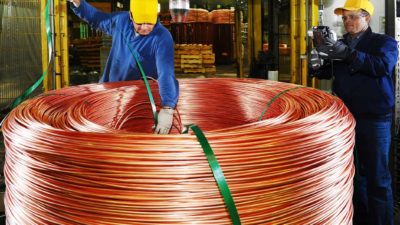
Image source: Getty Images
What has driven Rio Tinto shares higher this year?
Renewed confidence in the outlook for copper and iron ore – the two key commodities that Rio Tinto produces – has been a strong tailwind for the miner's share price this year.
The price of iron ore climbed to a multi-year high in May, while copper spiked to an all-time high in early June.
Commodity prices aren't the only thing driving the miner's share price higher.
In April, Rio Tinto also posted impressive first-quarter FY26 production results, revealing a 9% year-on-year increase in copper equivalent production.
Iron ore production in the Pilbara region also jumped 13%, making it the second-best Q1 production since 2018, despite weather disruptions and reduced shipments.
Rio Tinto also confirmed that it is focusing on expanding production volumes across its core commodity assets.
Why is the share price falling today?
There isn't any recent price-sensitive news out of Rio Tinto to explain today's share sell-off. It's likely a combination of softer commodity prices and investors taking their gains off the table after the latest rally.
According to Trading Economics data, copper futures are around US$6.3 per pound, down from a high of around US$6.7 per pound earlier this month.
Meanwhile, iron ore has fallen below US$101 per tonne and is now around 9% lower than a month ago.
The ongoing Middle East conflict continues to put pressure on commodities, thanks to higher supply chain costs and tighter global supply.
Over the long weekend, Israel and Iran exchanged strikes for the first time since an April ceasefire, raising fears of a broader regional conflict. The fighting has since ceased, but concerns about future attacks highlight ongoing volatility in the region. Investors are on the edge of their seats, waiting to see what happens next.
Are the shares a buy, sell, or hold now?
Market Index data shows that analysts are mostly split between hold and buy ratings, but the latest $172.97 target price implies a potential 3% downside for Rio Tinto shares.
TradingView data reflects something similar. Seven out of 16 analysts have a buy or strong buy rating on the shares. Another seven have a hold rating, and two have a strong sell rating on the miner's stock.
The average $180.23 target price implies a potential 0.2% downside at the time of writing. Although the maximum $211.41 target price still implies Rio Tinto shares have the potential to climb another 17% over the next 12 months.