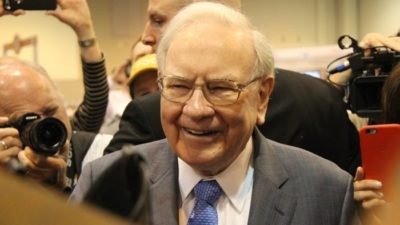
Warren Buffett, chair and (if only for the next few days) CEO of Berkshire Hathaway Inc (NYSE: BRK.A)(NYSE: BRK.B), is currently worth about US$147 billion. So one might be forgiven for thinking that you couldn't invest as Buffett does with as little as $500.
But you'd be wrong, well, mostly.
Sure, you'll need a lot more than $500 to direct the investing decision of a US$1.08 trillion company. But you can still invest the way Warren Buffett recommends without a fortune behind you.
Here in Australia, $500 is the minimum amount you will need to buy a stock or index fund on the Australian stock exchange. That's enough for one single investment.
Now, Warren Buffett recommends that all investors follow one of two paths if they wish to make money on the stock market. Both paths are open to our investor with $500.

Image source: Getty Images
How to invest like Warren Buffett with $500
Buy Buffett stocks
First up, we can buy shares of one company with our $500. However, Buffett is very selective about which companies he is willing to put money into. And since we can only choose one with our $500, we had better choose carefully.
So Buffett has told us on many occasions that he believes the best stocks to invest in possess what's known as a wide economic moat. This term refers to an intrinsic and permanent competitive advantage that a company can possess and use to ward off its competitors.
This 'moat' could be Apple's famous brand loyalty, for instance, or Coles Group Ltd (ASX: COL)'s ability to sell food and household essentials at some of the lowest prices available. It could be owning a product or an asset that consumers find difficult to avoid using. That could include Microsoft's Office suite, or one of Transurban Group (ASX: TCL)'s toll roads.
Here's how Buffett himself explained this concept back in 1995:
What we're trying to do is we're trying to find a business with a wide and long-lasting moat around it, protecting a terrific economic castle with an honest lord in charge of the castle. And in essence, that's what business is all about…
But what we're trying to find is a business that, for one reason or another… it can be because it's the low-cost producer in some area, it can be because it has a natural franchise because of surface capabilities, it could be because of its position in the consumers' mind, it can be because of a technological advantage, or any kind of reason at all, that it has this moat around it.
So you'll want to find a company that possesses one of these moats and is highly likely to still have it in 15 or 20 years' time. Once you have done so, you can use that $500 to buy shares of said company at a price that makes sense.
Go with an index fund
Buying individual stocks is obviously the more Buffett-esque path to follow. But the legendary investor himself has long argued that stock market investing isn't a great fit for everyone. For those who lack the time or temperament to successfully invest in individual stocks, Buffett recommends using a simple index fund. This is always an S&P 500 Index (SP: .INX) fund in Buffett's examples, but one could arguably substitute an ASX index fund.
Here's how Buffett explained why index funds make fine investments too, in 2013:
I have good news for these non-professionals: The typical investor doesn't need [investing] skill. In aggregate, American business has done wonderfully over time and will continue to do so (though, most assuredly, in unpredictable fits and starts)… The goal of the non-professional should not be to pick winners – neither he nor his "helpers" can do that – but should rather be to own a cross-section of businesses that in aggregate are bound to do well. A low-cost S&P 500 index fund will achieve this goal.
The good news for investors is that you can use $500 to buy either an S&P 500 or an ASX index fund here on the Australian markets. Two popular examples include the iShares S&P 500 ETF (ASX: IVV) and the Vanguard Australian Shares Index ETF (ASX: VAS).
Buffett warns investors going down this path that not trying to time the market is important. He warns that index fund investing relies on investing during all cycles, not just when markets are going up. This, according to the expert, is vital if you wish to make real returns.