This article was originally published on Fool.com. All figures quoted in US dollars unless otherwise stated.
Competition for the title of most valuable company in the world is heating up. Earlier this week Nvidia (NASDAQ: NVDA), after its monster run over the last few years, leapfrogged Microsoft and Apple to become the largest company in the world by market capitalization (market cap), the total value of all publicly traded shares of a company.
After topping its rivals, Nvidia slid back to third place, but this isn't any reason to fret. It's a tight race and the three are likely to be trading places for some time. The next round of earnings later this summer will be a major catalyst that could move the needle to a more stable place if any of the companies beat their own guidance and Wall Street's expectations -- or fall short.
No investing theme is more popular right now than artificial intelligence (AI) and Nvidia is its poster child. Investors are salivating at the incredible returns the company is delivering consistently quarter after quarter -- its revenue last quarter was up 260% year over year -- with the promise of continued growth into the future. Its rapid ascent since AI captured the public's attention is one for the record books. But what should investors pay attention to long term?
Understand what makes Nvidia special
Nvidia holds a unique position in the market. The company was so ahead of the curve that it was able to capture roughly 80% of the AI chipmaking business.
Of course, like most wildly successful companies, it was a matter of a little bit of luck and a lot of foresight. CEO Jensen Huang made a bet. Nvidia made chips called graphics processing units (GPUs) that were, for a large chunk of the company's history, accessories to the all-powerful central processing unit (CPU) that made Intel what it was. He saw that the industry was reaching the limits of scaling CPU technology and that his company's GPUs could step into the spotlight.
Turns out he was right. Without getting into too much technical detail, if you shift the focus to chips that are very like GPUs -- such as the company's Grace Blackwell "Superchip" -- with CPUs running a supporting role, you can run power-hungry applications and continue to scale them up. And AI is undoubtedly power-hungry.
Nvidia doubled down on this tech before it was fashionable, so when AI exploded onto the scene, the company was already there, supplying the entire industry with its tech. Now AI servers run by the likes of Alphabet, Amazon, and Microsoft are powered by Nvidia chips.
Whether AI pans out -- and when -- is critical
Nvidia went from a relatively niche computing company, mostly servicing the video game industry, to one of the largest companies in the world. Just look at this reversal of fortunes from the once-dominant CPU maker, Intel. The chart shows revenue for both companies over the last 10 years on a trailing-12-month (TTM) basis.
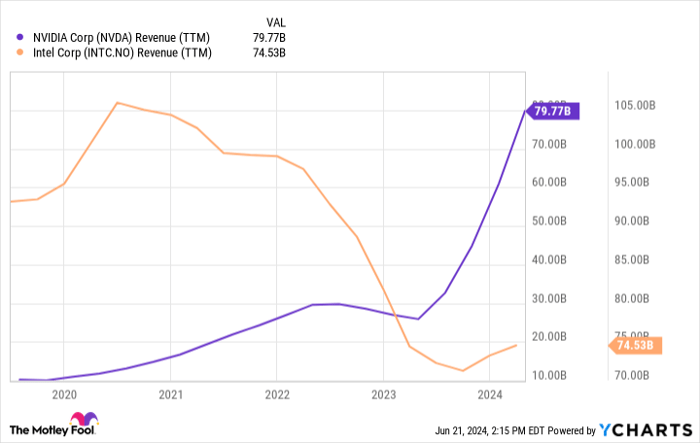
NVDA Revenue (TTM) data by YCharts
That is a twist of fate. But fate can be fickle. Nvidia's future largely depends on AI delivering on its promise. Much has been made of its revolutionary power, but there is still a lot to prove. It wouldn't be the first time a technology failed to deliver on the hype surrounding it. Still, I think there's more reason to believe AI isn't a fluke than some past hype cycles, so then it's a matter of when it can deliver.
If the AI value chain is a river, Nvidia is somewhere in the middle, upstream from the companies that actually deliver AI products to the end market. If those companies have overpromised on their products' value or can't deliver in time, the river gets dammed up downstream, potentially leading to a glut of unwanted chips. For Nvidia to continue the incredible growth it has been experiencing, enough to justify the premium value investors have placed on it, end-user demand has to keep the river flowing freely.
Keep an eye on how well the end-user AI applications are doing. Try some out. Do you see the value? The more useful these tools are, the higher the river's watermark and the more likely Nvidia is to deliver on its sky-high expectations.
This article was originally published on Fool.com. All figures quoted in US dollars unless otherwise stated.