Why surging bond yields are dragging the ASX 200 lower

Bonds are singing their siren song as interest rates look to be higher for longer.

| More on:
Three rock climbers hang precariously off a steep cliff face, each connected to the other with the higher person holding on and the two below them connected by their arms and rope but not making contact with the cliff face.

Image source: Getty Images

You’re reading a free article with opinions that may differ from The Motley Fool’s Premium Investing Services. Become a Motley Fool member today to get instant access to our top analyst recommendations, in-depth research, investing resources, and more. Learn More

The S&P/ASX 200 Index (ASX: XJO) is down 0.28% to 7,018.5 points in afternoon trade following a slump on Wall Street last night. Part of the burdensome weight on the share market's shoulders is the rising yield on bonds.

Overnight, the yield from United States 10-year Treasury bonds (a form of government-issued debt) surpassed 4.5%. The figure may not be too eye-catching in isolation. However, it represents the highest yield the bond has offered since 2007 — not long before the global financial crisis (pictured in the chart below).
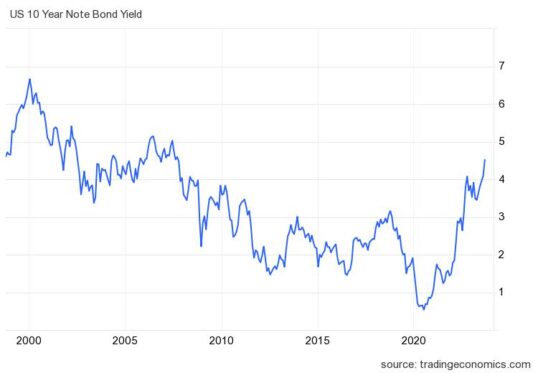
The rising bond yields follow commentary from the chair of the Federal Reserve, Jerome Powell. In a recent speech, Powell suggested interest rates may need to increase further still to rein in inflation. Or, at the very least, remain elevated for longer.

High bond yields crash the share market party

Rising yields on government debt might be taking the wind out of the share market's sails… but why?

In investing, there are vast options available for allocating our hard-earned cash to generate a return. Prior to the sudden COVID-induced burst of inflation, interest rates bopped around like an anchor at the bottom of the sea floor, holding back meaningful returns on cash or bonds.

Because of this phenomenon, investors lived in a world that unanimously proclaimed 'there is no alternative' — or TINA — to the stock market for achieving an acceptable return.

Now, interest rates are back to levels that are much more palatable, as central banks attempt to curb inflation. As such, investors are more inclined to park a larger portion of their wealth in bonds than in the share market, as bond yields close the gap on average long-term returns from stocks.

The bond market is also pricing in the chance of an additional interest rate increase. With that in mind, two other factors might be weighing down the Australian share market:

  • Higher rates would hurt consumer spending, and
  • Debt/funding could get more expensive for companies

If funding dries up due to attractive bond yields, it could jeopardise the solvency of some listed companies. According to S&P Capital IQ, nearly 33% of companies on the Australian Securities Exchange did not generate any revenue over the last 12 months — indicating a sole reliance on outside capital.

Why I'm not selling out of shares

Despite the bleak picture this might paint, I'm sticking with keeping the majority of my wealth in shares.

Bonds may well provide a decent return for a time. However, time has proven that the long-term returns from high-quality companies are superior. As such, my holdings in companies such as Jumbo Interactive Ltd (ASX: JIN), Pro Medicus Ltd (ASX: PME), and Apple Inc (NASDAQ: AAPL) — along with the rest of my portfolio — will remain.

If the economy weakens, I plan on increasing my positions in good companies at even more favourable prices.


Motley Fool contributor Mitchell Lawler has positions in Apple, Jumbo Interactive, and Pro Medicus. The Motley Fool Australia's parent company Motley Fool Holdings Inc. has positions in and has recommended Apple, Jumbo Interactive, and Pro Medicus. The Motley Fool Australia has recommended Apple, Jumbo Interactive, and Pro Medicus. The Motley Fool has a disclosure policy. This article contains general investment advice only (under AFSL 400691). Authorised by Scott Phillips.

More on Share Market News

A neon sign says 'Top Ten'.
Share Gainers

Here are the top 10 ASX 200 shares today

The ASX 200 broke its losing streak to inch higher today.

Read more »

A businessman in a suit adds a coin to a pink piggy bank sitting on his desk next to a pile of coins and a clock, indicating the power of compound interest over time.
Consumer Staples & Discretionary Shares

1 ASX 200 share to consider for the coming decade

I think this stock has a right decade in front of it.

Read more »

A man sitting at his dining table looks at his laptop and ponders the CSL balance sheet and the value of CSL shares today
Broker Notes

Buy, hold, sell: Flight Centre, Suncorp, and Zip shares

Let's see if analysts are bullish or bearish (or something in between).

Read more »

Wife and husband with a laptop on a sofa over the moon at good news.
Consumer Staples & Discretionary Shares

Bapcor shares soar 12% on the appointment of a new CEO

The market’s strong reaction reflects a clear message: investors are ready for a reset.

Read more »

A young woman drinking coffee in a cafe smiles as she checks her phone.
Share Gainers

Why Bapcor, IDP Education, Netwealth, and Ora Banda shares are pushing higher today

These shares are catching the eye with solid gains on Thursday. But why are they rising?

Read more »

Frustrated stock trader screaming while looking at mobile phone, symbolising a falling share price.
Share Fallers

Why Boss Energy, Paragon Care, Treasury Wine, and Woodside shares are falling today

These shares are having a tough session on Thursday.

Read more »

Business people discussing project on digital tablet.
Share Market News

Qube Holdings books $100m profit after selling Beveridge property

Qube Holdings announced a $111 million sale of its Beveridge property, delivering a material profit for FY26 accounts.

Read more »

Businessman working and using Digital Tablet new business project finance investment at coffee cafe.
Broker Notes

Does Macquarie rate Treasury Wine shares a buy the dip opportunity?

Let's see if the broker is bullish, bearish, or something in between.

Read more »