
One month ago, to the day.
On January 17 this year, I wrote:
The really bad news? If and when Holden's parent, General Motors, gets around to looking closely at an orphan brand…
…in a tiny market…
…on the other side of the world…
It's going to swing the axe.
Sad, but true.
Fast forward one lousy month, and yesterday GM did what GM must have known it was going to do.
It announced that Holden would be no more.
The once-proud Lion — Australia's Car, even if the Yanks owned the rego papers — already reduced to little more than a purr, will be silenced in short order.
A sad and ignominious end for a proud brand.
The car driven by the King of The Mountain, Peter Brock.
Driven (and had its mudguards shampooed) by Ted Bullpitt [editor's note: no, Bull-pitt] in Kingswood Country.
Owned by generations, including Darryl Kerrigan, who once asked his son: "Steve could you move the Camira? I need to get the Torana out so I can get to the Commodore."
And yes, my first car was a Kingswood (a Commodore was my 4th and 7th, from memory, too!)
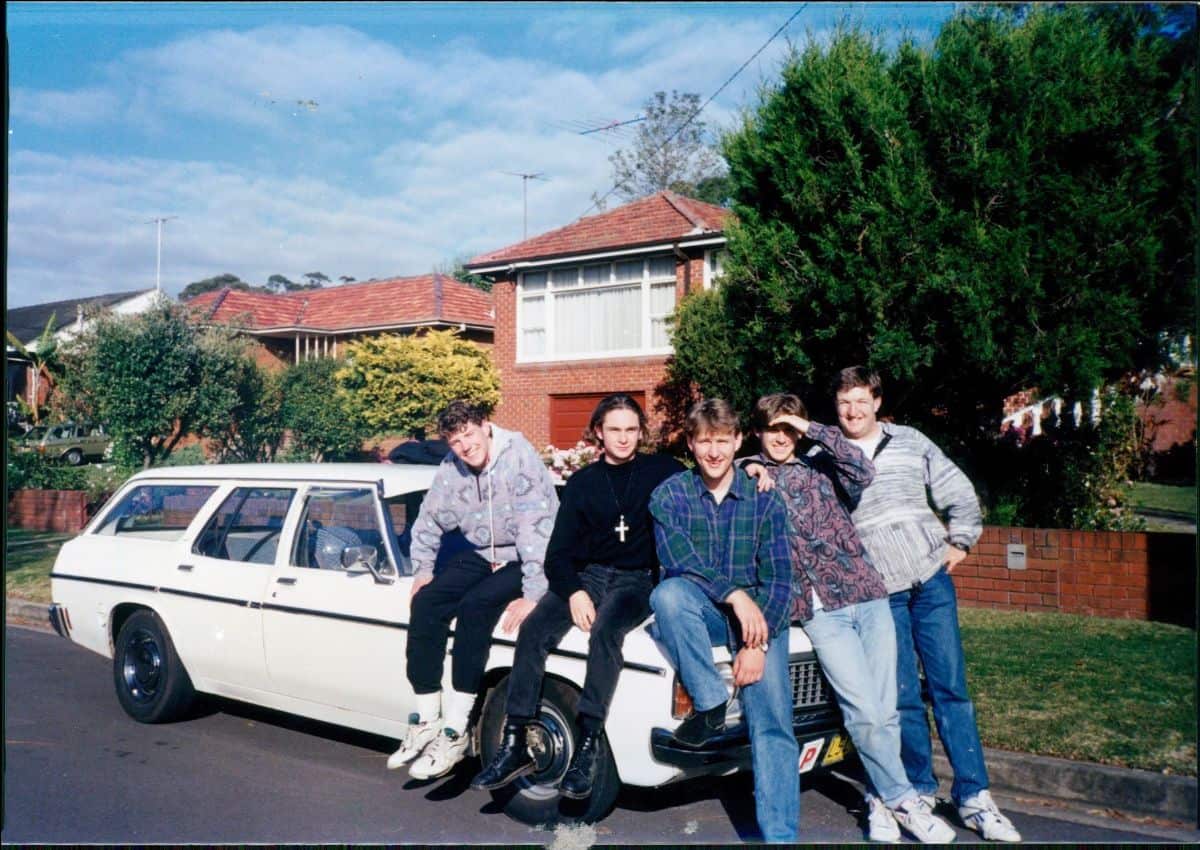
Yes, there was a time when I had hair. But I digress!
Back to Holden…
Maybe it's because I'm nostalgic at heart. Maybe it's because cars have an outsized place in our national psyche.
But the end of the line for Holden feels like a marker of the times.
We've moved on.
Technologically. Economically. Socially.
For the worse? Probably not. But it still feels jarring, doesn't it?
To the extent we ever cared about 'Buying Australian', that facade was wrecked when Bonds left the country all-but destroyed when Holden and Ford closed their factories, and obliterated now the brand is gone.
Holdens, even as pale US imitations, are no longer cutting the mustard. They ceased being 'ours', and suddenly (or maybe it just seemed that way) we realised that they simply weren't as good as we used to tell ourselves.
And our tastes changed.
'The market "bifurcated", as the boffins say. It split in two. Whereas the large family sedan was once the default middle-of-the-road choice, car buyers now either want small and economical, or big and 'capable'.
The Falcons, Commodores, Camrys and Magnas (remember them?) just didn't have a market any more.
The phrase "I'm going to buy a Holden because…" no longer had an obvious answer. Or a decently plausible one.
Don't get me wrong: I'm not saying they were terrible cars, or that no-one in their right mind would buy one. Just that Holden was now just one of a range of options — and volumes fell meaningfully as a result.
And when you're in a tiny market, you can't afford to be 'one of many'.
The axe had to be swung. And it was.
If there's any comfort for Holden (and it's cold comfort, if so) it's that General Motors is exiting all right-hand-drive markets.
From now on, it'll only make cars for left-hand-drive markets like the US and Europe. Apparently countries that drive on the correct side of the road (like Australia, obviously) make up only $1 in $4 of global car sales.
So, maybe, if GM hadn't make that unilateral global decision, Holden would have survived?
Maybe.
But not for much longer.
The numbers were awful. The dirge was being played, even if Holden true-believers couldn't — or didn't want to — hear it.
GM might have hastened its death, but Holden was already condemned.
The romantic in me is really sad to see it.
The pragmatist is, if not pleased, at least aware of why. And, on that level, it's not as bad as it might seem.
Oh, it's terrible for those directly losing their jobs at Holden. And for the dealer network that was desperately trying to breathe life into sales.
But it's not terrible for Australians, writ large. Or our economy.
First of all, though, let me say that our economy — any economy — is only ever there to serve its society. And the people impacted should be helped, to the greatest extent possible, in this transition.
(As an economy, we're undergoing the greatest transition since the Industrial Revolution, and we need to make sure don't leave people behind.)
Once done, just think of what this means: it's what economies are supposed to do — reward improvements (in price, features, quality) with more business, while removing business from those that are less desirable.
In other words, this process of 'creative destruction' is a series of incremental improvements that improve our standard of living.
As I've written before, you can buy a Camry today for around the same price as 15 years ago.
That's before allowing for inflation, making it cheaper in real terms.
And that's also before hugely improved fuel economy, more creature comforts (the 1998 Camry we drove until 4 or 5 years ago didn't have aircon or power windows) and a hugely improved range of safety features.
For less than it cost back then!
And we voted with our feet.
We bought the cars we wanted, and were better served (and safer) than in the past.
Would it really be better if those cars were lumped with huge tariffs? Would we really prefer lower quality cars, for higher prices? Is that really good for the country?
Of course not. At least not if we're thinking straight.
Oh, and by the way, Australian products are improving the lives of those in other countries, too. And we're making money from that.
The economists call it comparative advantage.
We're all better off if each country, region — and person — does what they're best at.
Let's take it local for a second. Imagine putting a border around the dozen suburbs closest to your home.
Can you imagine if we said:
Find your own iron ore (if you're lucky), grow your own crops (good luck getting mangos in Tassie or apples in Darwin), train and employ your own butchers (local cows, of course), bakers and candle-stick makers.
Generate your own power.
Make your own cars.
Your own computers.
Your own clothes and your own furniture.
Deal with your own rubbish and recycling.
And your own wastewater.
Find your own jobs.
It's possible, of course, but would you be better off than you are today, as a community?
I didn't think so.
We all specialise.
As a carpenter, I'm a great stock-picker.
As a plumber, I'm a great investor.
As a farrier, I'm a great financial advisor.
And I'm tipping the same is true in reverse.
Specialisation — comparative advantage — improves our standard of living enormously.
It's not just wishful thinking, or some sort of ideological flight of fancy, to think international trade is good for us all.
Think of how well the mining industry, tourism or education would perform, if we ceased exporting those industries.
We buy their cars. They come to our universities.
We buy their computers. They take our iron ore.
We buy their clothes. They buy our lobsters.
Feels like a pretty good swap to me.
(Remember, when we talk about modern Australia being built 'on the sheep's back', we're not talking about clothing Australians, but about growing our economy through selling much of that wool overseas!)
In one of the millions of parallel universes, Australia's Holden has huge, low-cost factories right around the country, exporting cars to the rest of the world, after management foresaw the needs of the world's car-buyers and built the perfect vehicle.
But the reality is that once Holden became a subsidiary of GM, it was never going to invest to build a global car in a geographically remote, high-wage economy.
Which is actually — and stay with me — a good thing.
Don't we want Australians employed in higher wage jobs, improving those people's standard of living?
Of course we do.
That's the reality behind the rose-coloured glasses, and overtly-political sloganeering from both sides in Canberra.
If we have to sacrifice low-wage jobs to build a stronger economy, we should do it (again, making sure we support those workers who are impacted.)
It is, as I wrote a month ago, also a reminder for us as investors.
Romance doesn't pay the bills.
Nostalgia doesn't compound very well.
Hopes and dreams won't buy tomorrow's paper.
As GM found out, you can't trade on 'yesteryear' forever.
Bookstores were wonderful until Amazon's (I own shares, for the record) growth killed most of them.
Ditto record stores and electronics retailers.
Cars replaced buggies.
Smartphones usurped the Walkman.
Digital photography destroyed Kodak.
It has ever been — and will ever be — thus.
You can yearn for the good old days. You can tell stories and fondly remember (and embellish) the past.
But you can't — mustn't — invest that way.
We have to, as ice hockey maestro Wayne Gretsky said, skate not to where the puck is, but to where it's going.
We have to invest in tomorrow's winners, not yesterday's.
No, it doesn't mean selling everything and investing in unproven, bleeding-edge technology.
It means looking at your portfolio, and asking yourself, clear-eyed, whether the companies you own can really continue to grow sales and profit at a meaningful enough rate to deliver you market-beating returns in future.
(Or, alternatively, if they're not, whether they're truly cheap enough to justify their middling performance.)
When I look at Woolworths Group Ltd (ASX: WOW), with a P/E of near-30, I worry.
When I look at Commonwealth Bank of Australia (ASX: CBA) — with declining earnings and a CEO who says growth is a challenge — with a P/E in the high teens, I worry.
Maybe I'm worrying unnecessarily.
Maybe there's an ace up the sleeve.
But if not, those shareholders could be in for a mediocre decade.
Now, that doesn't mean you should buy every fintech or 'neobank' stock out there. And there's more than one would-be Woolies-killer that has retreated with its tail between its legs.
It just means you have to look at the future, not the past.
Work out whether the companies you own — or would own — have futures that are bright enough to justify their share prices.
If they do, wonderful.
If they don't… you almost certainly shouldn't own them, potential tax bills notwithstanding.
Here's a simple test: Is the company likely to (continue to be) 'more relevant to more people' over time?
Will it gain more customers? Will existing customers spend more?
If the answer is yes to both, you have a potential investment candidate.
If not… the odds are against you.
That, in the end, is why GM closed Holden's doors.
Holden was a wonderful brand.
So was Kodak. And Blockbuster. And Angus & Robertson.
It's not unreasonable to want them back.
But, as they say, if wishes were horses, beggars would ride.
Wish all you want. Feel free to spend your consumer dollar accordingly.
But don't invest that way, unless you want your portfolio to go the same way as poor old Holden.
(And, as I said last month… if you have an HZ or EH you want to donate to a good cause, let me know!)
Fool on!