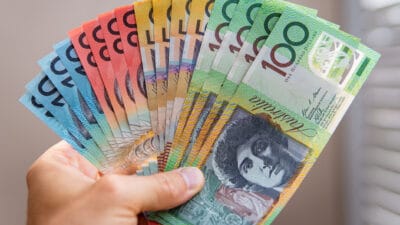
Replacing a salary with ASX dividend shares is the goal that drives most income investing.
A $90,000 income is a realistic target for many Australians.
That level sits just below average full-time earnings, which reached $2,083.70 a week in May 2026, or roughly $108,000 a year before tax.
So what would it actually take to generate $90,000 without working for it?
Image source: Getty Images
Why ASX dividend shares can do the job
Australian companies pay out more of their earnings than almost anywhere else in the world.
Franking credits are the reason.
Our system refunds the company tax already paid on dividends, which encourages generous payout ratios and makes ASX dividend shares unusually effective for generating income.
The maths on a $90,000 income
Let us use a real fund rather than a hypothetical portfolio.
Vanguard Australian Shares High Yield ETF (ASX: VHY) tracks the FTSE Australia High Dividend Yield Index.
The ETF holds 92 companies, charges 0.25% a year and manages a little over $8 billion.
The fund carries a forecast yield of 4.2%, or 5.5% once franking credits are included.
At 4.2%, generating $90,000 in cash distributions requires about $2.14 million. On the grossed-up figure of 5.5%, the number falls to roughly $1.64 million.
That difference is entirely franking credits.
These credits arrive as a tax offset rather than as cash in your account, so the answer lies somewhere between those two numbers depending on your marginal rate.
What you would actually own
VHY ETF is concentrated by design.
Its largest holdings are Commonwealth Bank (ASX: CBA), BHP Group (ASX: BHP), Westpac (ASX: WBC), National Australia Bank (ASX: NAB) and ANZ Group Holdings Ltd (ASX: ANZ).
That is a portfolio dominated by the major banks and one very large miner.
Performance has been strong recently, returning 17.87% over the year to 31 July 2026, and 10.22% annually over the past decade.
Distributions are paid quarterly, which suits anyone trying to replace a fortnightly or monthly pay packet.
How long it would take to get there
Someone investing $2,000 a month at VHY's decade-long return of 10.22% would pass $1.6 million in a little over 20 years.
Add a lump sum of $100,000 at the start and that timeline shortens by about three and a half years.
Reinvesting distributions also contributes to the compounding.
Drawing income early slows down your progress because every dollar spent along the way is a dollar that never compounds.
The catch with relying on ASX dividend shares
Dividends are not contractual.
Banks cut them in 2020, and miners cut them whenever commodity prices fall.
A 4.2% yield also assumes you never need to sell units to cover a shortfall.
Inflation is the other problem, and it is the one most income investors underestimate.
With the cash rate held at 4.35% and the Reserve Bank warning that inflation is still too high, a fixed $90,000 buys less every single year.
An income portfolio needs to grow its distributions, not simply pay them.
Foolish takeaway
Somewhere between $1.6 million and $2.1 million is the most representative answer.
That may sound like a large number, and it takes decades of contributions and compounding to reach.
The encouraging part is that you do not need to get there in one leap.
Reinvesting distributions along the way does most of the heavy lifting.
For anyone building toward financial independence, ASX dividend shares remain one of the most practical tools available.