The Woodside Energy Group Ltd (ASX: WDS) and Santos Ltd (ASX: STO) share prices are attracting attention this week as oil prices jump sharply.
At the time of writing, the Woodside share price is down 3.19% to $29.77, while the Santos share price is down 0.69% to $7.20.
Despite the modest declines today, both energy producers have been trending higher recently. Woodside shares are up around 5.5% over the past week, while Santos has gained almost 6% over the same period.
A key reason behind the renewed interest in the sector is the rapid rise in global oil prices.

Image source: Getty Images
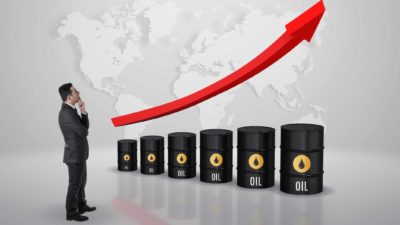
Oil prices surge over the past week
Oil markets have moved sharply higher in recent days.
West Texas Intermediate crude is currently trading around US$75.66 per barrel, while Brent crude is sitting near US$82 per barrel.
That represents an increase of roughly 16% over the past week for both major benchmarks.
Oil markets can often move quickly when geopolitical risks rise, particularly when the Middle East is involved. The region remains one of the most important oil producing areas in the world.
Investors are now watching developments closely to see whether supply risks become more serious.
Woodside is highly leveraged to oil prices
The recent move in oil prices is particularly relevant for Woodside.
The company is Australia's largest listed oil and LNG producer, with major operations spanning Western Australia, the Gulf of Mexico, and other international regions.
Because Woodside sells its production into global energy markets, stronger crude prices generally translate into higher realised prices for its output. In turn, this typically leads to higher revenue, stronger operating cash flow, and improved returns for shareholders.
With a market capitalisation of roughly $56 billion, Woodside remains the largest energy company on the ASX.
Santos also benefits from stronger crude prices
Santos is another major Australian oil and gas producer that is closely tied to movements in global energy markets.
The company operates oil and gas assets across Australia, Papua New Guinea, Timor-Leste, and Alaska, supplying energy into both domestic and international markets.
With a market capitalisation of about $23 billion, Santos is the ASX's second largest oil and gas producer.
Can the oil rally continue?
The key question now is whether crude prices can hold onto their recent gains.
Oil markets can be highly volatile, particularly when geopolitical tensions are involved. This is especially true in the Middle East, one of the world's most important oil producing regions.
If supply concerns continue to build, higher crude prices could keep supporting the outlook for energy producers.
The next few weeks may prove important in determining whether the latest oil rally has further room to run.