Australian counter-drone technology company DroneShield Ltd (ASX: DRO) says the total addressable market for its systems is worth US$63 billion globally, with buyers across military and civilian sectors just getting started on procurement.
The company on Thursday released its 2025 Total Addressable Market Report, which says the proliferation of "uncrewed" systems across air, land, and sea is "transforming global security''.
And while the use of drones was once limited to defence, as the barriers to entry for drone technology continue to fall, "the challenge of securing airspace and perimeters grows exponentially''.
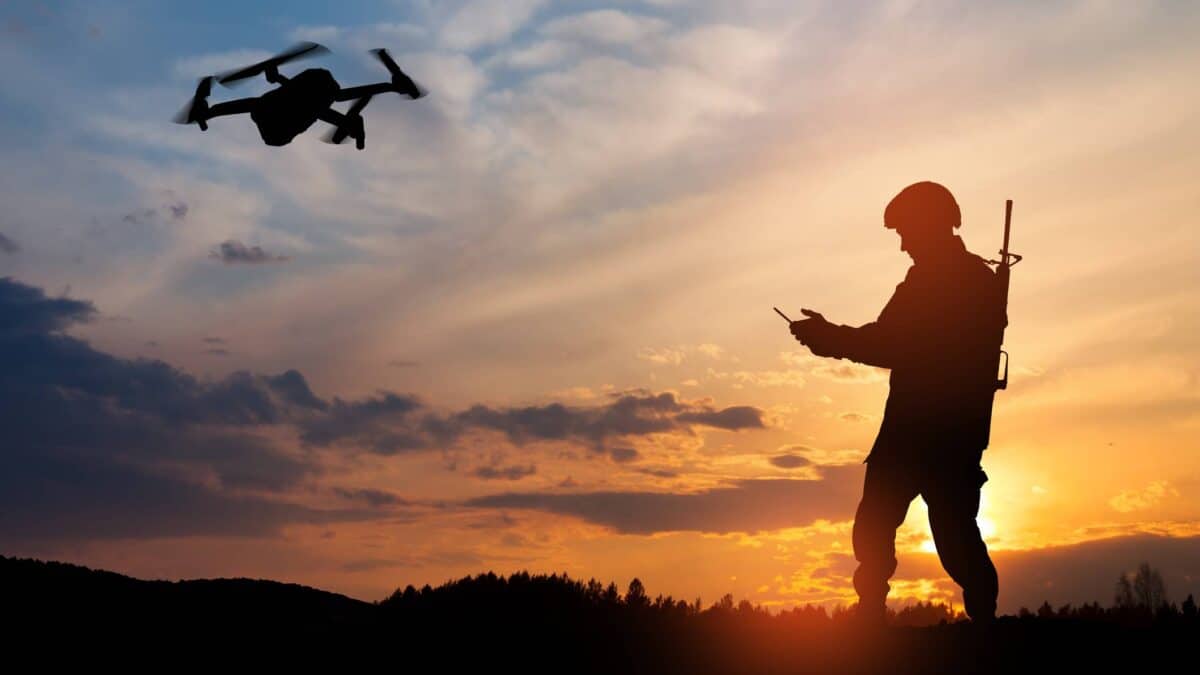
Image source: Getty Images
Investment starting to accelerate
The report says the counter-uncrewed systems (CUxS) market was entering a phase of accelerated expansion, with demand split between military use at 56% and civilian infrastructure at 44%.
Military demand is led by mounted and portable systems for vehicles, bases, naval vessels, and helicopters, while the civilian market is driven by the protection of airports, energy grids, ports, data centres, correctional facilities, and public venues.
The report says the market is rapidly transforming from pilot programs to scaled deployment, and the use of artificial intelligence, both in terms of drone control and detection, is growing quickly.
As the report says:
AI-enabled detection and defeat layered defence architectures, and sovereign capability will define the next era of counter-drone adoption.
Counter-drone tech becoming critical
DroneShield Chief Executive Officer Oleg Vornik said counter-drone technology had moved "from a niche military capability to a critical component of national and civil security infrastructure''.
This data reinforces that counter-drone demand is broadening beyond the military sector into every major sector that depends on airspace integrity. Additionally, this highlights how early we are in the adoption cycle – all of our military customers are only starting mass procurement at this stage, and the civilian customers have a substantial amount of catch up to do, to enable the protection against this rapidly growing threat, as the most recent drone disruptions across multiple countries in Europe have demonstrated.
The DroneShield report says the largest single market sector was the integration of counter-drone systems across about 180,000 frontline-capable military vehicles globally.
This included armoured vehicles, tactical transports, and mobile command units.
As drones are increasingly used for reconnaissance and attack in contested environments, mounted CUxS capabilities are becoming standard across NATO and Indo-Pacific forces.
The 180,000 figure was based on just 15% of the estimated 1.2 million such vehicles in use globally, for a market size of US$20.3 billion.
On the civilian front, the protection of government and intelligence facilities, as well as border protection, were each market segments worth US$2.4 billion, while airport protection was worth another US$3.2 billion, the report states.
Police forces were also increasingly adopting counter-drone technology, with that segment worth US$550 million.
DroneShield also this week released a major new software platform.
DroneShield shares closed at $5.10 on Wednesday on the ASX, valuing the company at $4.46 billion.
The shares are up about ninefold from their low over the past 12 months of 58.5 cents.