This article was originally published on Fool.com. All figures quoted in US dollars unless otherwise stated.
Key Points
- Tesla aims to replicate its Model S triumph with its latest strategic vision.
- The company is building upon its automotive and energy businesses with the help of AI.
- Tesla's third quarter boasted record vehicle deliveries and energy storage deployments.
Electric vehicle (EV) manufacturer Tesla (NASDAQ: TSLA) achieved fame and fortune after its Model S car came out in 2012. The automobile not only boosted the company's ascent, but the entire EV market as well.
The Model S showed what was possible with an electric car. From the ability to travel long distances to a self-driving mode, the vehicle broke the mold in terms of the public's perception of an EV. I thought it was a game-changer at the time, and that's why I bought the car, as well as Tesla stock.
Now, the company is racing to repeat its Model S success. This time, it's a different type of auto, as in the automated kind. And while artificial intelligence is part of the equation, the next groundbreaking achievement isn't just about AI. It's what the company calls "sustainable abundance."
What Tesla means by "sustainable abundance"
Tesla periodically publishes a master plan describing long-term goals. In the latest version, the company outlined its future vision, stating, "This next chapter in Tesla's story will help create a world we've only just begun to imagine and will do so at a scale that we have yet to see."
Tesla predicts a future where technology is used sustainably to create boundless prosperity for all, a concept it describes as "sustainable abundance." The idyllic aspiration may sound appealing, but how can it be achieved in practical terms?
As a step toward its ambition, the company stated, "We are building the products and services that bring AI into the physical world." One example is its robotaxi service, which Tesla launched in June as a pilot program in Austin.
This program uses a modified version of its Model Y vehicles to start. Over the long run, Tesla intends to construct an AI-driven car with no steering wheel called the Cybercab.
The company plans to produce a fleet of Cybercabs in 2026 using its innovative "unboxed" manufacturing strategy. This vehicle construction technique employs several modular assembly lines rather than being constrained to a single, linear process.
How Tesla is pulling together its long-term vision
Self-driving cars are only the beginning. Tesla is building humanoid robots controlled by AI. The idea is that these robots will provide labor for dangerous or monotonous work, freeing up time for people to pursue more enjoyable endeavors.
Another piece of the company's vision is the sustainable aspect. For this, Tesla looks to its solar energy business. This segment saw a stupendous 67% year-over-year sales growth in 2024, contributing $10.1 billion of the company's $97.7 billion. However, through the first half of 2025, revenue growth in this area has slowed, reaching $5.5 billion compared to $4.6 billion last year.
Of course, Tesla's far-reaching objectives will take years to accomplish, and 2025 was a tough one for several reasons. Business performance was hindered by macroeconomic factors, which include tariffs combined with a drop in Tesla's popularity due to the actions of its divisive CEO, Elon Musk.
That said, the company managed to achieve a record number of vehicle deliveries and energy storage product deployments in the third quarter, although that's likely due to consumers rushing to take advantage of federal EV tax credits before they expired in September. Full business performance details will be unveiled on Oct. 22, when it's scheduled to release its Q3 earnings report.
Is now the time to buy Tesla stock?
Tesla's Model S launch demonstrated its ability to deliver technological innovation and execute on goals others thought unattainable. Its "sustainable abundance" plan is even more ambitious, but perhaps it can repeat the Model S feat.
The company's vision of a futuristic world with AI, autonomous vehicles, and humanoid robots has the potential to fundamentally change society. But Tesla must advance its robotaxi service as an initial step on this path.
If that proves successful, Tesla stock could skyrocket. In fact, shares are up around 80% over the past 12 months through Oct. 8. Yet as a result, its share price valuation has soared.
This chart looks at Tesla stock's price-to-earnings (P/E) ratio, which indicates the amount investors are prepared to pay for each dollar of earnings over the trailing 12 months, revealing it's higher in October than it's been over the past year.
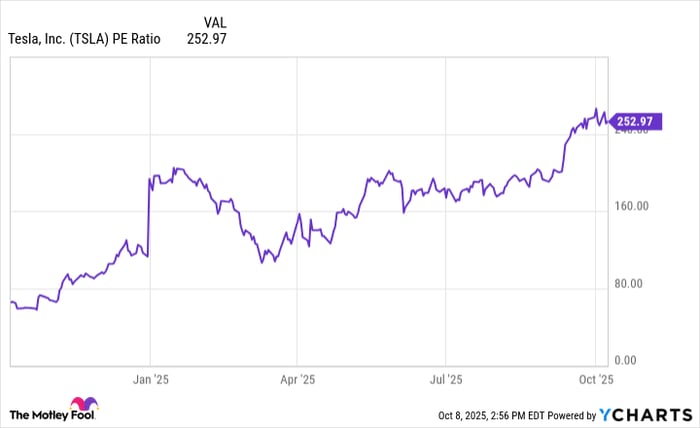
Data by YCharts.
With a P/E multiple of around 250, Tesla stock is quite expensive. The sky-high valuation creates risk when investing in shares right now.
If you believe in Tesla's vision and that the company can achieve success with its robotaxi service and robots out of a sci-fi movie, then the prudent approach is to wait for the share price to drop before deciding to invest.
This article was originally published on Fool.com. All figures quoted in US dollars unless otherwise stated.