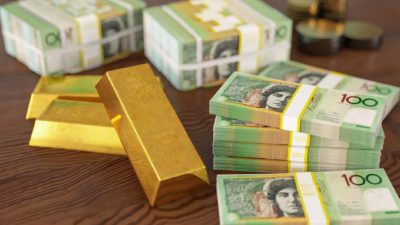
The rise in the gold price that we've seen in 2025 has been nothing short of extraordinary. So keen are investors and central banks to buy gold that the price of the yellow precious metal has risen from around US$2,600 an ounce at the start of this year to the US$3,864 it commands today.
That's a gain worth 48.15%, well above what any stock market, or most other assets for that matter, have returned.
Given this incredible runup, many ASX investors might be wondering how they can get in on the action. There's always the option of buying physical bullion if one wants to buy gold, of course. However, many investors don't want to worry about the hassle of buying and storing heavy gold bars or coins.
Luckily for those investors, exchange-traded funds (ETFs) provide a compelling alternative. Gold ETFs work by holding a store of the precious metal, usually in a bank vault somewhere, and offering investors a chance to indirectly invest in that gold stockpile by buying units of the ETF.
The price of these units should move in tandem with the price of gold, allowing investors to obtain a return if the gold price continues to rise. There is no need to own physical metal itself with this strategy, although this does come with the drawback of having to pay the ETF provider an annual fee.
Let's talk about a few ASX ETFs that might suit an investor wishing to buy gold today.

Image source: Getty Images
Buy gold with these ASX ETFs
The simplest funds that offer exposure to the gold price include the Global X Physical Gold Structured ETF (ASX: GOLD) and the Perth Mint Gold ETF (ASX: PMGOLD). Both of these ETFs work in the manner described above. The Global X fund holds its gold store in a London vault, while Perth Mint Gold's stores are held locally in Perth.
Critically, both funds offer investors who wish to buy gold unhedged exposure to the precious metal. This means that the units will reflect the price of gold in Australian dollar terms rather than US dollars.
This can be beneficial if the price of gold rises in US dollar terms whilst the value of our dollar falls. However, it can work against investors if our dollar gains strength relative to the greenback.
The Global X Gold ETF charges a management fee of 0.4% per annum, while Perth Mint Gold asks a far cheaper 0.15% per annum.
For investors who wish to take that currency factor out of the equation, there are also ETFs that offer hedged exposure available. These will give investors a 'purer' exposure to gold, meaning that movements in our dollar won't affect the value of the ETF, only the price movements of gold itself.
Investors have a few options to consider if this is the path they wish to take. Two examples are the BetaShares Gold Bullion Currency Hedged ETF (ASX: QAU) and the Global X Gold Bullion (Currency Hedged) ETF (ASX: GHLD).
Bear in mind that hedged ETFs can often be more expensive to own than their unhedged counterparts. To illustrate, GHLD units will set investors back 0.35% per annum, while QAU will cost 0.59% per annum.