How to turn $100 into $1,000 by investing

This is the way to turn your hard-earned money into considerably more.

You’re reading a free article with opinions that may differ from The Motley Fool’s Premium Investing Services. Become a Motley Fool member today to get instant access to our top analyst recommendations, in-depth research, investing resources, and more. Learn More

For many new investors, the idea of turning a small amount of money into something meaningful is the ultimate goal.

And while it is possible, the reality is that a single $100 investment will take a long time to turn into $1,000. Even with strong compounding, it could take decades for a one-off $100 to grow into a ten-bagger.

But there is a smarter way to grow wealth. By consistently investing $100 every month, you could smash through the $1,000 milestone and begin building real wealth over time.
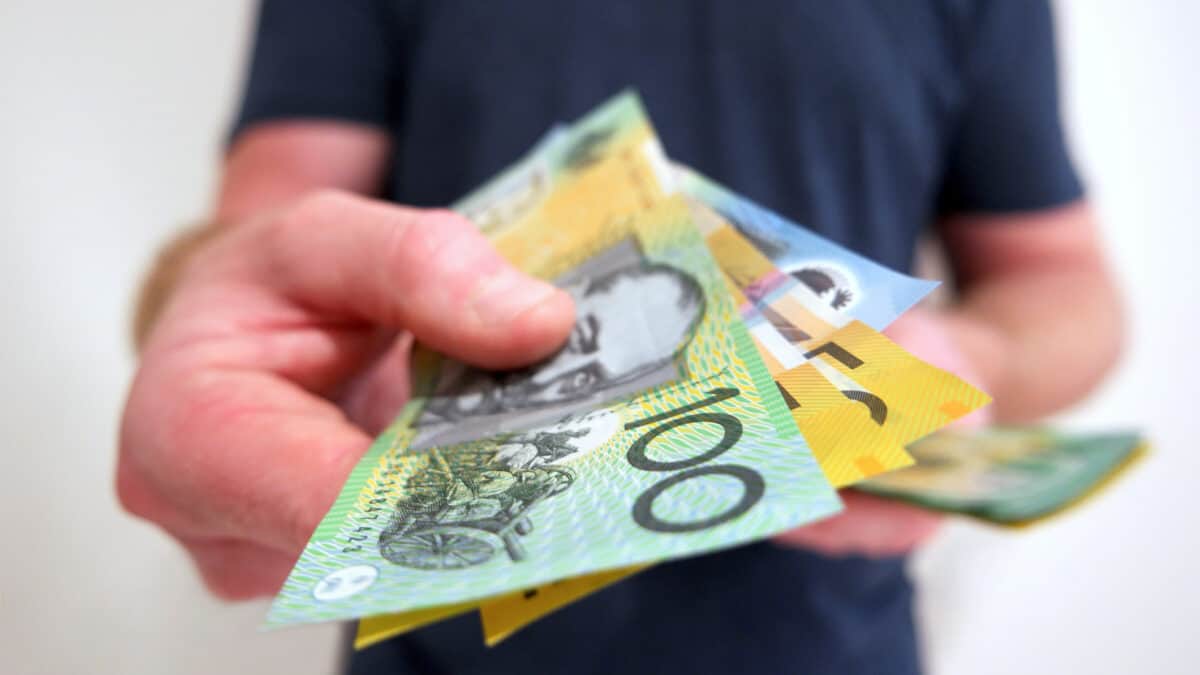
Person handing out $100 notes, symbolising ex-dividend date.

Image source: Getty Images

The power of regular investing

If you invest $100 each month into the share market and earn an average annual return of 10% (in line with historical share market averages, but not guaranteed), you would grow your portfolio to just over $20,000 in 10 years.

That's a massive leap on the original target, with compounding doing the heavy lifting as your returns generate more returns. In other words, the $1,000 target becomes a stepping stone, not the finish line.

How to get started with $100

The good news is you don't need to be wealthy to start. Low-cost micro investing apps, like Pocket from Commonwealth Bank of Australia (ASX: CBA), make it possible to begin with as little as $50 per trade. That means everyday Australians can start building an investment portfolio straight from their smartphone.

And when it comes to what to buy, simple, diversified exchange-traded funds (ETFs) are often the best option for beginners.

One option is the Betashares Nasdaq 100 ETF (ASX: NDQ), which gives you exposure to global tech leaders such as Apple (NASDAQ: AAPL), Microsoft (NASDAQ: MSFT), and Nvidia (NASDAQ: NVDA).

For broader global coverage, the iShares Global 100 ETF (ASX: IOO) holds blue-chip companies across multiple industries, including Tencent Holdings (SEHK: 700), LVMH Moet Hennessy Louis Vuitton (FRA: MOH), and McDonalds (NYSE: MCD).

And for those wanting exposure to the Australian market, the iShares Core S&P/ASX 200 ETF (ASX: IOZ) is a low-cost way to invest in the country's 200 largest companies, such as BHP Group Ltd (ASX: BHP), Telstra Group Ltd (ASX: TLS), and Westpac Banking Corp (ASX: WBC).

Foolish takeaway

Turning $100 into $1,000 won't happen overnight. But by consistently investing $100 a month into high-quality ETFs, you could achieve that milestone quickly and keep going far beyond it.

With micro investing apps lowering the barriers to entry, there has never been an easier time for everyday Australians to start their investing journey. The key is to start small, stay consistent, and let compounding work its magic.


Motley Fool contributor James Mickleboro has positions in BetaShares Nasdaq 100 ETF. The Motley Fool Australia's parent company Motley Fool Holdings Inc. has positions in and has recommended Apple, BetaShares Nasdaq 100 ETF, Microsoft, Nvidia, and Tencent. The Motley Fool Australia's parent company Motley Fool Holdings Inc. has recommended the following options: long January 2026 $395 calls on Microsoft and short January 2026 $405 calls on Microsoft. The Motley Fool Australia has positions in and has recommended BetaShares Nasdaq 100 ETF and Telstra Group. The Motley Fool Australia has recommended Apple, BHP Group, Microsoft, and Nvidia. The Motley Fool has a disclosure policy. This article contains general investment advice only (under AFSL 400691). Authorised by Scott Phillips.

More on How to invest

A woman has a thoughtful look on her face as she studies a fan of Australian 20 dollar bills she is holding on one hand while he rest her other hand on her chin in thought.
How to invest

How to invest smart: Avoid these 3 common pitfalls

Investing is all about discipline, patience, and knowing what not to do.

Read more »

A man in his office leans back in his chair with his hands behind his head looking out his window at the city, sitting back and relaxed, confident in his ASX share investments for the long term.
How to invest

I think this simple ASX investing habit can build wealth over time

You don’t need complex strategies to succeed in the share market.

Read more »

Cheerful boyfriend showing mobile phone to girlfriend with a coffee mug in dining room.
How to invest

If I had to build a simple ASX portfolio today, this is what I'd do

A simple ASX portfolio can go a long way over time. Here’s how I’d structure one.

Read more »

A beautiful woman holds up one finger with one hand and has her hand on her waist with the other as she smiles widely as though she is very pleased about something.
How to invest

The Warren Buffett rule I keep coming back to with ASX shares

Instead of chasing cheap shares, this Buffett principle shifts the focus to something far more important.

Read more »

Woman with long hair smiles for the camera.
How to invest

Where I'd invest my first $500 into ASX shares

By focusing on simple, high-quality investments, it’s possible to build a strong foundation for long-term wealth from day one.

Read more »

A mature aged man looks unsure, indicating uncertainty around a share price
How to invest

How to invest in ASX shares when the market feels uncertain

Don't let volatility stop you from investing. Here's how to handle it.

Read more »

Workers planning together in a design team.
How to invest

How to build a $25,000 ASX share portfolio from zero

Time, compounding, capital, and good investments is all you need.

Read more »

A young female investor with brown curly hair and wearing a yellow top and glasses sits at her desk using her calculator to work out how much her ASX dividend shares will pay this year
How to invest

How to start investing in ASX shares with $1,000

The first investment is often the hardest. Here’s how I would approach it with $1,000.

Read more »