How to easily boost your investment returns without increasing risk

Traditional thinking is that higher the potential gains, the more risk you must take on. But there is a way around that.

Businessman using a digital tablet with a graphical chart, symbolising the stock market.

Image source: Getty Images

You’re reading a free article with opinions that may differ from The Motley Fool’s Premium Investing Services. Become a Motley Fool member today to get instant access to our top analyst recommendations, in-depth research, investing resources, and more. Learn More

An old investment axiom is that higher the returns, the higher the risk.

And that is largely true.

But there is one neat trick that investors can pull to push up their returns without absorbing additional risk.

How? 

Betashares director Patrick Poke spilled the secret on a blog post:

Efficiency = higher returns

Poke describes the trick as "efficiency".

"This means reducing fees and costs. By reducing costs, investors can improve their net returns, without needing to take on additional risk," he said.

"These can be fixed fees like account keeping fees and brokerage fees, or they can be asset-based fees, charged as a percentage of your investment, such as management costs."

There are also the less obvious expenses.

"One often overlooked cost is called 'cash drag'. This is the cost of leaving parts of your money uninvested – i.e. sitting in cash.

"Depending on where those funds are sitting, you could be earning zero interest, a low interest rate, or a savings account interest rate."

This isn't money that you're saving for some tangible purpose, such as to cover living expenses, reduce volatility, or to use to buy bargain shares.

"Cash drag occurs when you have money that you intend to invest but haven't made those investments yet."

Fees and cash drag — some investors might say they make negligible difference.

But just like how the magic of compounding turbocharges your investments over the long term, these costs add up and multiply over time.

Surely the investment returns couldn't be that much higher?

Let's take management fees in exchange-traded funds (ETFs) as an example.

If you have two funds with similar risk and performance, but one charges 1% per annum while the other levies a 0.04% annual fee, the end difference can be astounding.
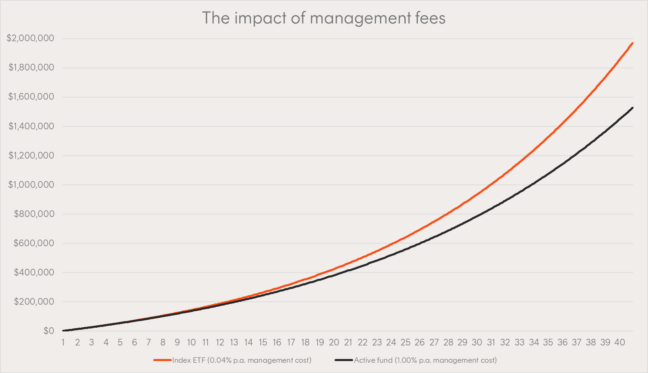
Source: Betashares. Hypothetical example provided for illustrative purposes only. Not a recommendation to invest or adopt any investment strategy. Actual results may differ materially.

Poke compared the results after 40 years of investing.

"Assuming the return is the same for both funds, the investor paying the higher fee ends up with $1,526,020, while the investor paying the lower fee ends up with $1,970,010," he said.

"That's $443,990, or 29% more!"

And check out the effect of cash drag. 

Poke looked at what happens when an investor adds $1,000 each month to the portfolio compared to if they saved up that cash to invest it all at the end of each year.

"The annual investor ends up with $1,838,577 at the end of year 40, while the monthly investor ends up with $1,970,010.

"Investing monthly resulted in a balance that was $131,433, or 7.1% higher."

So the moral of the story is that a few dollars at the time of transaction may not seem like much, but they can have a significant impact on the performance of your portfolio.

"They can really add up over a long period. And when you account for the compounding of returns, the difference can be significant."


Motley Fool contributor Tony Yoo has no position in any of the stocks mentioned. The Motley Fool Australia's parent company Motley Fool Holdings Inc. has no position in any of the stocks mentioned. The Motley Fool Australia has no position in any of the stocks mentioned. The Motley Fool has a disclosure policy. This article contains general investment advice only (under AFSL 400691). Authorised by Scott Phillips.

More on How to invest

A woman sits in a quiet home nook with her laptop computer and a notepad and pen on the table next to her as she smiles at information on the screen.
How to invest

How to build a $100,000 ASX share portfolio starting at zero

Want to build a big portfolio? Here's the easiest way to do it.

Read more »

A man holding a sign which says How do I start?, indicating a beginner investor on the ASX
How to invest

Start buying shares in December with a spare $500? Here's how!

The best time to start investing is right now.

Read more »

Suncorp share price Businessman cheering and smiling on smartphone
How to invest

How to invest your first $1,000 in the share market the smart way

My first investment would look something like this if I were starting again.

Read more »

Beautiful young couple enjoying in shopping, symbolising passive income.
How to invest

The smart way to make a $25,000 passive income from ASX shares

This could be the smart way to make your money work for you.

Read more »

Happy young couple saving money in piggy bank.
How to invest

$20,000 in savings? Here's how you can use that to target an $8,000 yearly second income

Having $20,000 saved is more powerful than most people realise. Not because $20,000 can produce an income today, but because…

Read more »

A smiling woman with a handful of $100 notes, indicating strong dividend payments
How to invest

How to turn $50 a week into a six-figure ASX share portfolio

Small investments could grow into big wealth with this strategy.

Read more »

Excited couple celebrating success while looking at smartphone.
How to invest

Why today's cheap ASX shares could double my money during the next bull market

These shares could be the ones to buy if you are looking for undervalued options.

Read more »

A businessman compares the growth trajectory of property versus shares.
How to invest

The 10-year wealth plan: how to turn small savings into life-changing results

Building wealth doesn't need to be hard. Here's a simple plan you can follow.

Read more »