This article was originally published on Fool.com. All figures quoted in US dollars unless otherwise stated.
What happened
Shares of big tech stocks Apple (NASDAQ: AAPL), Microsoft (NASDAQ: MSFT), and Intel (NASDAQ: INTC) all moved significantly higher today, rocketing 6.2%, 6.6%, and 5.5%, respectively, as of 12:33 p.m. ET.
Those are massive moves for companies that big, but today was no ordinary day. After basically a year of negative surprises in the monthly Consumer Price Index (CPI) releases, with some exceptions, today's CPI print was lower than expected, fueling hopes of a Federal Reserve pause on its aggressive interest rate hikes.
These tech giants are each at least partially exposed to the troubled PC sector, which has been one of the hardest-hit areas of tech. While enterprise spending on cloud and servers has been hanging in, the prospect of more interest rate hikes or recession had led to fears another shoe was to drop. So today's print was especially positive, given that the sooner inflation declines, the sooner the Fed can stop hiking interest rates, and the greater the possibility of avoiding a recession.
So what
Obviously, Apple and Microsoft make the two main operating systems for virtually all PCs, and Intel's largest business segment is its PC processors. Therefore, each stock had seen a big sell-off this year, despite their size, moats, and relatively limited competition.
Of note, technology research firm Gartner projects that third-quarter PC shipments were down a stunning 19.5% year over year -- the biggest drop since it began tracking PC shipments in the 1990s.
So why is today's CPI print so important in relation to PC sales? Well, the rapidly rising interest rate hikes tend to hit interest rate-sensitive items hardest first, which are usually big-ticket items like housing, autos, home electronics, and business fixed investments, which these days include data centers and enterprise PCs.
Add to that the fact that so many consumers bought new computers during the 2020-2021 timeframe, and could therefore defer the purchase of a new computer, and the rapid shift in rates led to a huge air pocket in PC sales. So, the potential for a pause in interest rate hikes could give big-ticket items a boost from their current severe downturn.
Apple has held up much better than others, as it had fallen "only" 23.6% this year, as opposed to 32.8% for Microsoft and 44.5% for Intel.
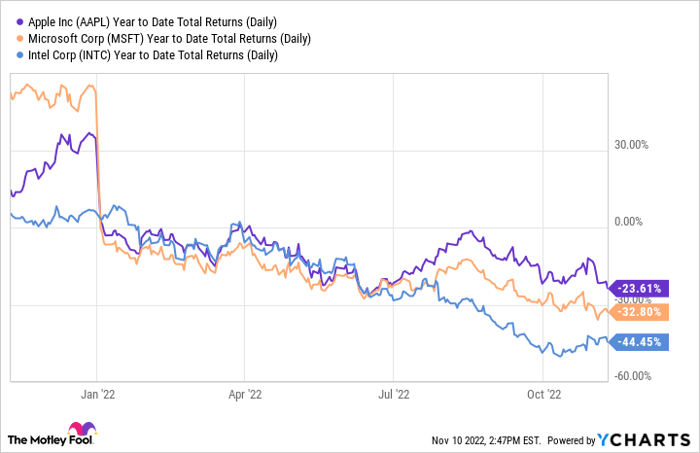
AAPL Year-to-Date Total Returns (Daily) data by YCharts
It's somewhat surprising that Apple has done better than Microsoft, given that it was thought consumer spending on electronics is generally weaker than enterprise spending. Microsoft's More Personal Computing segment, which is geared toward consumer-facing PCs, video games, and Bing digital advertising, is only 30% or so of the business, as opposed to Apple being predominantly a consumer-facing company, so it's strange that Apple had held up better than Microsoft this year. The outperformance does go to show how strong Apple's brand is and how much of a staple the iPhone is.
Intel has really been feeling the pain of the PC downturn this year, because that had been the company's cash cow. New Intel CEO Pat Gelsinger has ambitious plans to catch up to Taiwan Semiconductor Manufacturing in leading-edge semiconductors by achieving five node transitions in four years, while also building out a massive foundry ecosystem to serve third-party chip designers.
That's incredibly hard and very expensive to do, which is why the plummet in PC sales has been so harmful to Intel this year, as it deprived the company of needed cash to execute its investment plans. That's why Intel has traded down to just a single-digit P/E ratio this year.
Given the shellacking these stocks have already taken, and given that the market is forward looking, it's no surprise they are ripping higher at the prospect of inflation cooling off.
Now what
Given the lags with which the Fed's economic policy operates, investors should know that while inflation is slowing, it's because the economy is also slowing. Over the coming months, the Fed will try to keep rates high enough to cool inflation further, without tipping the economy into a recession. Despite today's rally, that's still a tricky proposition.
A recession would be bad news for all stocks, but of these three, especially Intel, since it is in a capital-intensive hardware business.
On the other hand, today's promising CPI print could allow the Fed to slow down or even stop its rate increases. That would be good for all economically sensitive stocks, as long as the economy doesn't have too bad of a downturn.
As is often the case, Apple and Microsoft still look like strong core holdings for the long term, even in spite of this year's declines. With Intel, an investment really comes down to your belief in CEO Pat Gelsinger's vision and ability to execute. If the turnaround works, Intel stands to have the most upside of these three names; however, if all that spending doesn't result in solid returns or Intel catching up to Taiwan Semi in leading-edge technology, it could be a problem, even if Intel's stock does look cheap today.
This article was originally published on Fool.com. All figures quoted in US dollars unless otherwise stated.