On announcing Australia had entered a recession in 1990, then treasurer Paul Keating uttered the now notorious line "this is a recession Australia had to have". More than three decades on, the United States (US) appears to be teetering on a recession born from a similar economic situation.
Australia's 1990s recession was brought about, in part, by efforts to reduce inflation.
Nowadays, the US Federal Reserve is hiking interest rates in a bid to fight the same measure. It upped the nation's benchmark rate by 0.75% to a range of 3% to 3.25% last week.
The move came just weeks after US inflation was found to have come in higher than expected in August.
And experts are tipping more pain to come. Most of the US's Federal Open Market Committee expect interest rates to surpass the 4.5% priced into markets, my Fool colleague Bernd reports.
Could the US be about to suffer through an inevitable recession as Australia did in the 1990s?
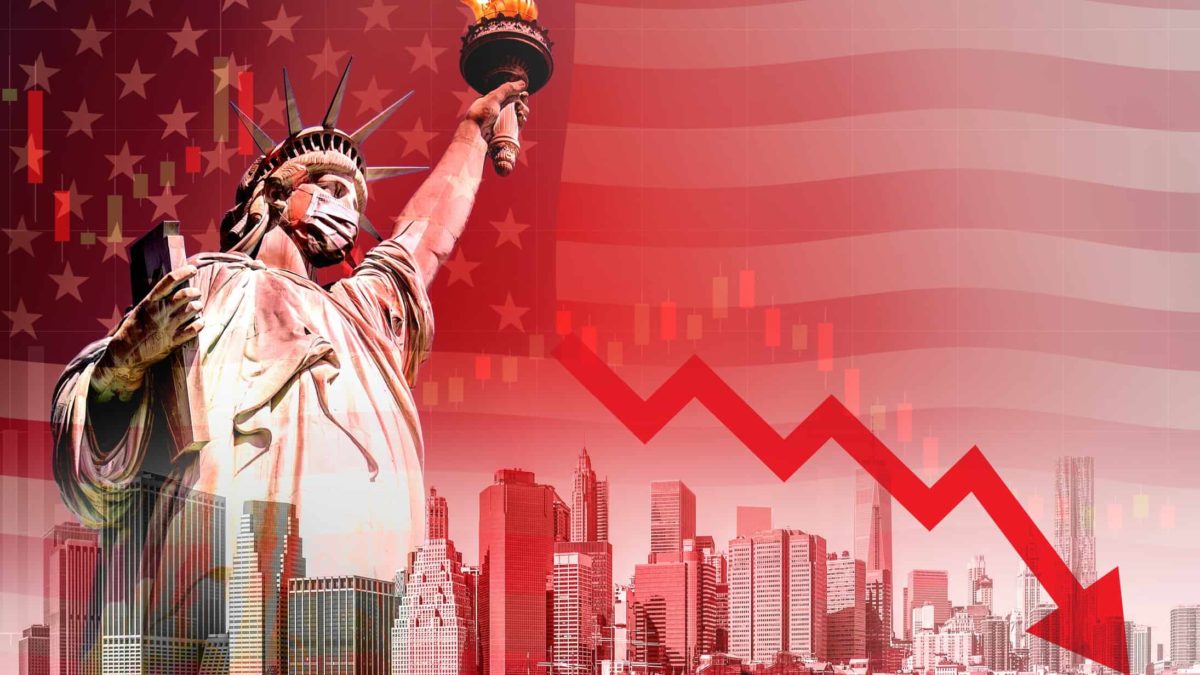
Image source: Getty Images
Is the US on the path to recession?
It's been more than thirty years since Keating heralded a recession as one that "Australia had to have". Though, it was a sentence the then treasurer later admitted he regretted, saying:
[I]t did not reflect the government's policy, and it was a statement which seemed too uncaring at the time. The government was never after a recession. Policy was only about a slowdown.
Right now, the US is looking at a vastly different environment than Keating once did, despite some notable parallels. One major difference, for example, is low US unemployment, coming in at 3.7% in August.
Still, some experts are tipping the US to enter a recession in the near future.
Ophir Asset Management director Andrew Mitchell is one such expert. He recently noted, courtesy of The Australian:
We think it is very likely the US will end in recession. The Federal Reserve's reputation is on the line and [chair] Jerome Powell is most likely to overcorrect and go too tight on monetary policy, which will have damaging effects on the global economy.
Barclays is reportedly also predicting a US recession. It expects the interest rate to peak at a target range of 4.5% to 4.75% in February, driving a "shallow recession", the Australian Financial Review reports.
But not all is dire…
Fortunately, Australians, and ASX fans, still have plenty to be hopeful of.
HSBC chief economist for Australia, New Zealand, and global commodities Paul Bloxham tipped Australia to dodge the worst of a global economic slowdown ahead of his keynote presentation at Flight Centre corporate's Illuminate 2022 conference. He said:
While inflation is running at around 8% in US and 9% in Europe, its growth in Australia has fortunately been slower. We forecast Australia will avoid a recession, unlike some other countries.
Additionally, investors might find comfort in predictions that, if the US does fall into a recession, it will likely be a tame one.
Morgan Stanley chief investment officer of wealth management Lisa Shalett says inflation-triggered recessions are generally less severe than others, continuing:
Aside from the pandemic-induced 2020 recession, other recent recessions have been credit-driven.
By contrast, excess liquidity, not debt, is the most likely catalyst for a recession today.
The difference is important for investors. Historically, damage to corporate earnings tends to be more modest during inflation-driven recessions.
Beyond that, the words of The Motley Fool Australia's chief investment officer Scott Phillips could bring comfort to anxious investors.
Phillips correctly points out, despite market crashes, recessions, pandemics, and many more apparently disastrous events, the ASX has gained an average of 9% annually over the last three decades. He writes:
In a world where people want to tell you, at every turn, how complex and difficult investing can be, I humbly disagree … I think the future is bright, not because there are no obstacles for us to climb, but despite the fact there are obstacles to climb.
It has always been thus. And that's the lesson of economic and stock market history.