Is dollar cost averaging the way to invest in Bitcoin?

Dollar cost averaging can smooth out your investment returns without needing to time the market.

| More on:

You’re reading a free article with opinions that may differ from The Motley Fool’s Premium Investing Services. Become a Motley Fool member today to get instant access to our top analyst recommendations, in-depth research, investing resources, and more. Learn More

Bitcoin (CRYPTO: BTC) is down 1.7% over the past 24 hours, currently trading for US $43,564 (AU$59,872).

If crypto investors believe this represents a low point, should they invest a large sum of money into Bitcoin today?

Or is it better to ignore the price swings and invest a fixed amount into the token on a consistent basis?

The latter strategy is called dollar cost averaging.

Traditionally it's been used by share investors looking to smooth out their returns without trying to time the market. But is it suitable for cryptos?
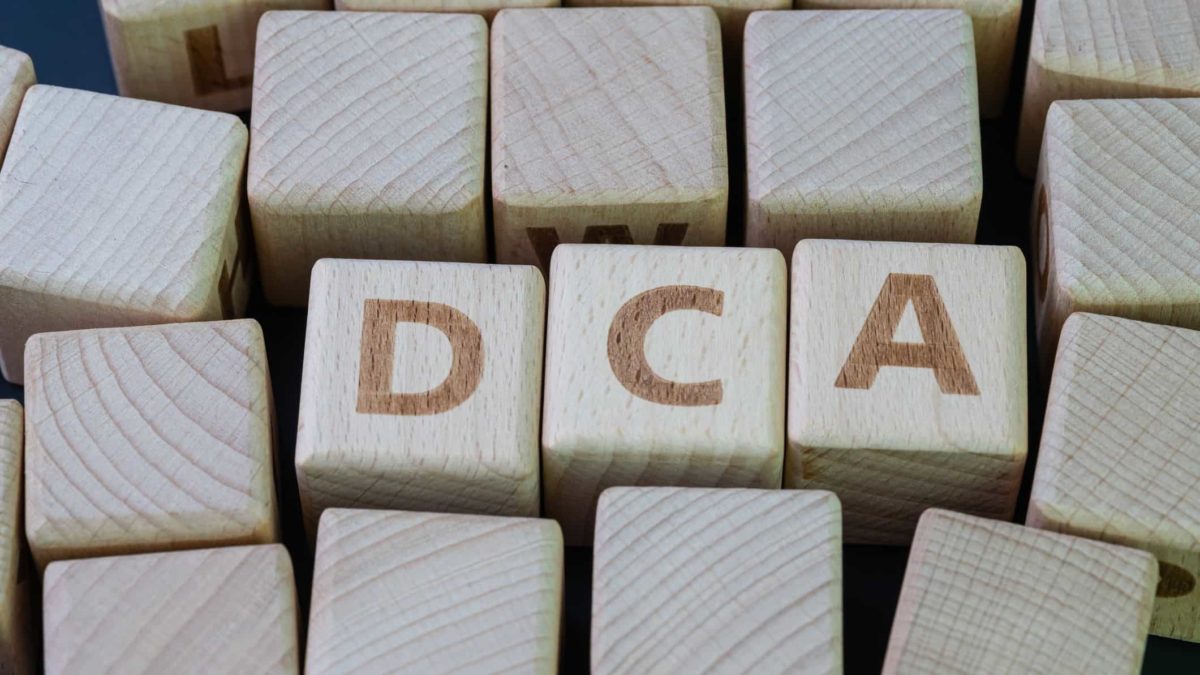
wooden block letters spelling DCA

Image Source: Getty Images

Is dollar cost averaging the way to invest in Bitcoin?

It was only on 10 November that Bitcoin hit all-time highs of US$68,790. A good time to sell, perhaps. But certainly not the time to go all-in.

On the flip side, over the past 12 months Bitcoin dripped as low as US$28,894 on 20 July.

With perfect hindsight, that would have been a great time to buy.

But in the crypto world, as in share markets, we're not gifted with hindsight months in advance.

Which brings us back to dollar cost averaging

Adam Traidman, is the CEO and crypto company BRD. And, as CNBC reported, Traidman uses dollar cost averaging for his own Bitcoin investments. He invests a fixed amount into the token at set times, ignoring the daily price swings.

According to Traidman:

Casual investors have a tendency to buy into the hype cycle and sell when the losses become a reality. It's crazy, illogical thinking, but it happens all the time. Why would people buy high and sell low? Well, they don't want to, but they sell out of fear.

As for when the Bitcoin price does take a tumble?

"I'm not letting [the price drop of Bitcoin] bother me, because I'm confident that the price performance charts have shown that it's going to return in the long term," Traidman said.

He added that, "Dollar cost averaging ends up making sense in the long term. If you contribute a little bit every time, in the long term you end up with a pretty darn good return if you can weather all the ups and downs."

Gemini on dollar cost averaging for cryptos

Global crypto trading platform Gemini also sounds off on the potential benefits of dollar cost averaging.

The company notes that, "Cryptocurrencies can be quite volatile, oftentimes even more so than stocks."

On its website Gemini notes that while investors may miss out on some potentially big gains, dollar cost averaging is likely to lower the risks:

You can generate a potentially greater profit from buying during dips and selling at the top. However, there's broad consensus that DCA [dollar cost averaging] is a safer overall method of investing than lump sum buying and selling. It's lower risk and lower reward, but still offers the chance of benefiting from market swings.

And when we're talking about an asset like Bitcoin, there are plenty of market swings to potentially benefit from.


The Motley Fool Australia’s parent company Motley Fool Holdings Inc. owns shares of and has recommended Bitcoin.  The Motley Fool Australia has no position in any of the stocks mentioned. The Motley Fool has a disclosure policy. This article contains general investment advice only (under AFSL 400691). Authorised by Bruce Jackson.

More on How to invest

A beautiful woman holds up one finger with one hand and has her hand on her waist with the other as she smiles widely as though she is very pleased about something.
How to invest

The Warren Buffett rule I keep coming back to with ASX shares

Instead of chasing cheap shares, this Buffett principle shifts the focus to something far more important.

Read more »

Woman with long hair smiles for the camera.
How to invest

Where I'd invest my first $500 into ASX shares

By focusing on simple, high-quality investments, it’s possible to build a strong foundation for long-term wealth from day one.

Read more »

A mature aged man looks unsure, indicating uncertainty around a share price
How to invest

How to invest in ASX shares when the market feels uncertain

Don't let volatility stop you from investing. Here's how to handle it.

Read more »

Workers planning together in a design team.
How to invest

How to build a $25,000 ASX share portfolio from zero

Time, compounding, capital, and good investments is all you need.

Read more »

A young female investor with brown curly hair and wearing a yellow top and glasses sits at her desk using her calculator to work out how much her ASX dividend shares will pay this year
How to invest

How to start investing in ASX shares with $1,000

The first investment is often the hardest. Here’s how I would approach it with $1,000.

Read more »

A banker uses his hands to protect a pile of coins on his desk, indicating a possible inflation hedge.
How to invest

Stagflation: How to position an ASX stock portfolio

Investing with stagflation might become a necessity on the ASX...

Read more »

A man thinks very carefully about his money and investments.
How to invest

How to build a second income from ASX shares without taking big risks

You don't have to risk it all to build a second income on the share market.

Read more »

A couple are happy sitting on their yacht.
How to invest

A 2026 market crash could be a once-in-a-decade chance to build a $1 million ASX portfolio

The investors who built lasting wealth didn't avoid market crashes. They used them.

Read more »