



ESG investing is based on environmental, social, and governance considerations. It is becoming increasingly important for investors who are looking not only for financial returns but also to positively impact the world through their investment choices.
This investment style is also known as socially responsible, sustainable, green, and impact investing — and increasingly, investors and fund managers favour these alternative labels, as "ESG" itself has become a contested term in some markets (more on that below).
ESG investors prioritise strong environmental, social, and governance outcomes alongside the usual economic factors when making investment decisions. This means considering non-financial factors that can meaningfully affect investment risk and growth opportunities.
Underlying the move towards ESG investing is the idea that companies are more likely to thrive and deliver strong returns if they create value for all their stakeholders, including shareholders, employees, suppliers, customers, and the wider community. Essentially, ESG investing promotes the premise that good corporate behaviour means better business results, and that companies can mitigate risk and improve returns by proactively managing ESG issues rather than ignoring them.

Image source: Getty Images
What does ESG stand for?
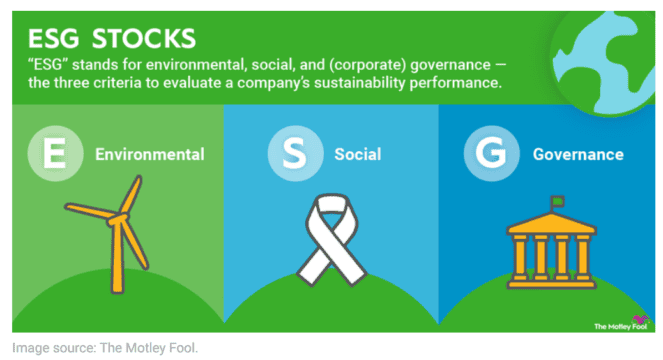
ESG is an acronym for the three pillars that are critical considerations in this investment style — environment, social and governance. We can break down each of the pillars of ESG investing into constituent considerations, which vary across industries.
Environment
Conservation of the natural world — Environmental factors include how a company safeguards and protects natural resources through its operations. They encompass such considerations as:
- Direct and indirect greenhouse gas emissions
- Waste production, including hazardous and non-hazardous waste
- Direct and indirect energy consumption
- Water usage, whether drawn directly from a water source or via intermediaries such as water utilities
Social
Consideration of people and satisfaction — Social factors can include the following considerations for company conduct:
- Relationships between employees, suppliers, customers, and the communities in which the companies operate
- Human capital management, health and safety issues, and minimum wage concerns
- Workforce culture, gender diversity, and data security
- External social factors such as animal welfare, social opportunities, and product liability.
Governance
Standards for running a company — Governance factors consider the hygiene standards within a company's internal operations and encompass:
- Accurate and transparent accounting methods
- Voting rights of shareholders on important issues
- The avoidance of conflicts of interest for board members
- Ensuring companies comply with laws and don't use political contributions to obtain unduly favourable treatment.
Why invest in an ESG company?
ESG investing is seen as a way to invest sustainably and has risen alongside a growing focus on corporate social responsibility. ESG investors recognise the interdependencies between social, environmental, and economic issues. Astute investors realise that incorporating sustainability factors into their investment decisions can enhance long-term returns.
There are few (if any) areas of business operations where ESG considerations are irrelevant. However, different companies may give ESG factors different weight. Just as individual investors come to the market with particular values and motivations, companies will prioritise various ESG factors in their operations.
The prioritised factors will depend on what the company considers more critical, given its circumstances. For example, companies in the energy industry will have quite different ESG considerations from companies in the technology sector.
ESG investment strategies
There are different strategies available to those looking to invest following ESG principles. These include:
- Negative screening: Where sectors or companies that do not align with the ESG considerations of the investor are excluded from investment consideration.
- Positive screening: Where investors seek companies that are outperforming or improving faster than their peers on ESG measures or seek to invest in companies solving specific ESG issues (such as climate change).
- ESG integration: Where investors integrate ESG criteria alongside traditional financial data into their investment selection process.
- Impact investing: Where investors target a specific social or environmental impact, with investments generally project-specific
- Active ownership: Where shareholders engage with companies on ESG issues to initiate changes in corporate behaviour
Each approach will result in differing outcomes for investors and the companies they invest in. There is no overall consensus on which strategy is 'best' — this will depend on each investor's goals.
How popular is ESG investing?
ESG investing surged over the past decade, but the picture has become more complicated since 2023, with real growth in some markets alongside a notable backlash and rebranding trend in others.
In Australia, the responsible investment market has continued to expand. According to RIAA's most recent Responsible Investment Benchmark Report, Australia's responsible investment market reached a record $1.6 trillion, with RIAA-certified products growing 24% to $167.7 billion in assets under management. The proportion of responsible investment assets under management rose from 36% to 41% of the total managed funds market, and institutional demand remains a key driver of growth, with 53% of respondents citing it as a contributing factor.1
Globally, though, "ESG" as a label has faced real pushback since 2024–25. Political criticism, inconsistent ratings, and greenwashing scandals have made investors and asset managers wary of the term itself, even as underlying practices continue. Over 335 European funds rebranded away from ESG terminology in Q1 2025 alone, with 116 dropping it entirely in favour of terms like "sustainable" or "screened".2 This part of a broader trend called "greenhushing," of firms quietly downplaying ESG in public communications.
New ESG fund launches globally slowed sharply in early 2025, dropping to 54 in the first quarter compared with 105 in the previous quarter, partly reflecting performance concerns in ESG-heavy sectors like clean energy, and partly reflecting tighter regulatory definitions that have made it harder to market products as "ESG."3
The takeaway for Australian investors: while ESG and responsible investment assets continue to grow domestically, the global conversation is shifting away from broad ESG branding toward more specific, substantiated claims. This trend is likely to keep shaping how Australian fund managers describe and structure their own products.
How is index investing linked to ESG?
Whether investing in index funds is ESG investing depends on the index. In many cases, the answer is no. This is because index investing is, by nature, impartial. An index such as the S&P/ASX 200 (ASX: XJO) does not consider ESG factors.
This means to invest under ESG principles, an additional layer of selection is needed. These days, however, some indexes consider ESG considerations and exchange-traded funds (ETFs) that follow these indexes.
This means investors can access diversified portfolios of companies that meet the environmental, social, and governance criteria required to be included in ESG investment indexes. Examples such as the S&P Global Clean Energy Index and Nasdaq Future Australian Sustainability Leaders Index make it easier for index investors to invest sustainably.
What are the challenges of ESG investing?
Greenwashing is marketing sustainability credentials without matching action — remains the biggest risk for ESG investors, and Australian regulators have gotten serious about policing it.
Since 2024, ASIC has secured a run of record penalties: Mercer Superannuation was fined $11.3 million for "Sustainable Plus" funds that still held fossil fuel, alcohol, and gambling stocks; Vanguard was fined a record $12.9 million over misleading fossil-fuel exclusion claims on an ethical bond fund; and Active Super was penalised $10.5 million for misleading ESG representations. The lesson for investors: a fund's name or marketing copy isn't a reliable guide to its actual holdings. Checking disclosure documents matters.4
ASIC dropped greenwashing from its explicit 2026 enforcement priorities, suggesting these penalties already achieved their deterrent effect, though routine surveillance continues. A Senate inquiry into greenwashing is also due to report in mid-2026. As always, look past headline sustainability claims and check a fund's actual portfolio holdings, not just its stated screening criteria.
Foolish takeaway
Ultimately, the rise of ESG investing is likely to positively impact the environment, social issues, and company governance. Increasing awareness of these factors means companies must take concrete action to improve internal practices and avoid negative externalities.
For investors, the increasing popularity of ESG investing means it is easier than ever to invest in a way that supports positive environmental, social, and governance outcomes.
Want to learn more about investing?
You've come to the right place!
This article is part of Motley Fool Australia's comprehensive Investing Education series, covering everything from budgeting and saving to basic investing concepts and how much money you'll need to start.
Packed with easy-to-understand and regularly updated information, our articles contain the answers to your most frequently asked questions about share market investing.
Motley Fool's Education series is tailored for beginner and experienced investors alike and also includes helpful tools and resources, an A-Z glossary of Investing Definitions, and guides to specific topics of interest, including retirement planning, gold and property investment.
- The previous article in this section is about long-term investing
- Check out our next article on adding international exposure
