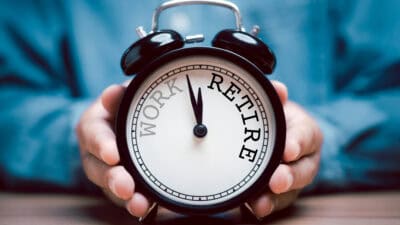
At age 60, you've reached preservation age, meaning you can retire and start drawing down on your superannuation. It also means you're just seven years away from potentially receiving the Centrelink Age Pension.
The Age Pension is a fortnightly sum designed to help older Australians finance their lifestyle in retirement.
The only thing is. Not everyone is eligible. The amount you can get depends heavily on your income and the assets that you own.
The income test assesses all of your income, pooled from all sources. That includes anything from superannuation contributions and investment income to part-time wages, bonuses, passive income, and commission payments.
And the rules are constantly changing, as do the thresholds and maximum potential payments.
And overlooking or misunderstanding your limits means you could see yourself earn less, or nothing at all, when the time comes.
Here are six things every Australian at age 60 needs to know about the Age Pension income test before they retire.

Image source: Getty Images
1. Eligibility is strict
To be eligible for the Age Pension, you need to meet basic requirements ahead of the income or asset test.
That is, you need to be 67 years old (or older). You also need to be an Australian resident who has lived in Australia for at least 10 years, with at least five of those years in a continuous period.
2. The maximum potential payment is about to change
From the 20th of September, the maximum fortnightly Age Pension payment will go up to $1,237.70 for individuals. Couples will soon get up to $933 per person per fortnight, or $1,866 combined.
These figures include the maximum basic rate, the maximum pension supplement, and the energy supplement.
3. Income limits for the maximum rate will stay the same
The income limits won't change next week. To receive the full Age Pension, single Australians can earn up to $226 per fortnight. Meanwhile, couples can earn up to $396 per fortnight.
Individuals can earn up to an extra $24.60 per fortnight for each dependent child without reducing their pension. Couples living together and both getting a pension can each earn an extra $12.30 per fortnight for each dependent child.
4. Age Pension deeming rules apply, and they're also about to change
To calculate how much income you receive from your assets, Centrelink uses what it calls a "deeming rule".
Deeming assumes your financial assets earn a fixed, set rate of income, regardless of what they actually earn. This assumed income is then added to any other income to determine your final Age Pension rate.
And these rates are about to go up, too.
As of the 20th of September, the lower deeming rate increases from 1.25% to 1.75%, while the upper rate increases from 3.25% to 3.75%.
For single Australians, the first $66,800 of financial assets will soon be deemed at a rate of 1.75%. Over that threshold, the assets will be deemed at the new 3.75% rate.
For couples, the lower 1.75% rate applies to the first $110,600 of combined financial assets, with the higher 3.75% rate applied to anything above.
5. Don't panic, a part payment is still possible
If you're over these levels, it's still possible to earn some level of Age Pension payment before the payment reduces to zero. And thankfully, these are also about to get a boost next week.
Single Australians can earn up to $2,701.40 per fortnight, and couples (living together) can earn up to $4,128 per fortnight combined and still qualify for at least a part-Age Pension.
If you earn over the income limit and below these cut-off points, your income is assessed on a sliding scale. For a single person, your Age Pension will reduce by 40 cents for each dollar over $226, and for couples, it will reduce by 20 cents for each dollar over $396.
6. Centrelink uses what is called "the lower rule of two"
Centrelink assesses you under both an income and an asset test and then applies whichever gives you the lowest rate of payment.