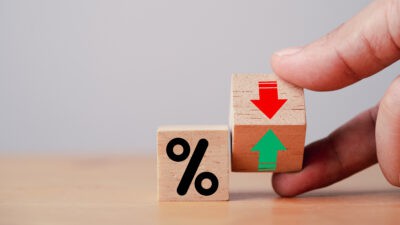
Superannuation has had an excellent run of late, and a rate rise this month would be the first real test of it.
The Reserve Bank of Australia meets on 29 September. Morgan Stanley expects a hike, which would be the first move higher in this cycle.
Most Australians will not think about what that means for their retirement savings. But given the implications, this question is worth five minutes of your time.

Image source: Getty Images
How your superannuation has actually performed
The average superannuation fund did well in FY26.
Chant West estimates the median growth fund returned around 9% in FY26, making it a fourth consecutive year of strong returns.
International listed shares did most of the heavy lifting.
Every asset class delivered a positive return over the year with the single exception of Australian real estate investment trusts.
It's important to compare this performance to two broadly-held ASX market ETFs.
Vanguard Australian Shares Index ETF (ASX: VAS) tracks the S&P/ASX 300 Index across 321 securities for a fee of 0.07% a year.
The fund returned 5.79% over the year to 31 July 2026 and 8.92% annually across the past decade.
Vanguard Australian Shares High Yield ETF (ASX: VHY) is far more concentrated, holding 92 companies led by Commonwealth Bank, BHP Group and the other major banks.
Its forecast yield is 4.2%, or 5.5% once franking credits are counted, and it returned 17.87% over the year to 31 July 2026.
What a rate rise would actually do
The Reserve Bank held the cash rate at 4.35% on 11 August.
Its statement left little doubt about the direction of future interest rates.
The Board will continue to do what it considers necessary to bring inflation sustainably back to target, including increasing the cash rate target further if upside risks materialise.
However, not everyone agrees the move comes this month.
For example, Westpac chief economist Luci Ellis sees November as the more likely date.
A hike would hit a superannuation fund in three places.
Bond prices fall when yields rise, so the defensive part of your portfolio takes an immediate mark-to-market hit.
Australian real estate investment trusts and infrastructure assets are repriced lower, because their long-dated cash flows are worth less.
Bank shares face slower credit growth and higher deposit costs, and they are a very large part of the local index.
The parts of your superannuation that would hold up
Not everything suffers.
Cash and term deposit allocations earn more, which helps anyone in a conservative or pension-phase option.
Similarly, resources companies are largely driven by commodity prices rather than domestic rates.
And then there are global equities, which are the biggest single driver of most balanced funds, and which respond to United States policy far more than Australian policy.
What I would not do
Switching your superannuation to cash ahead of a possible rate rise is the classic mistake.
You crystallise any loss, you miss the recovery, and you have to be right twice to come out ahead.
For investors who care about long-term returns, time in the market is much more important than timing the market.
Foolish takeaway
A September rate rise would trim returns, not wreck them.
Bonds and rate-sensitive Australian shares would take the hit, while cash and global equities would cushion it.
If your superannuation sits in a default balanced option and you have twenty years to run, the correct response is almost certainly nothing at all.
If you are drawing an income and are heavily weighted toward bank shares, it may be worth checking your allocation.
Either way, the decision should reflect your time horizon, which is usually much longer term than a single rate decision.