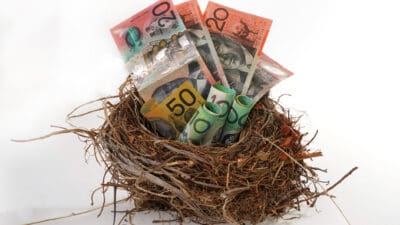
The amount of money you need in your superannuation to retire at age 65 depends nearly entirely on the type of retirement lifestyle you want to live, how long you live beyond retirement, and whether or not you own your home outright.
The ultimate goal for any soon-to-be retiree is to live a comfortable lifestyle after they stop working.
That's one where you can maintain a good standard of living, including top-level private health insurance and regular leisure activities. It would also allow you to own a reasonable car, have funds set aside for home repairs, and the occasional meal out. An annual domestic trip could also be on the cards.

Image Source: Getty Images
How much does a comfortable retirement cost?
Thanks to rising inflation and the cost of living, the Association of Superannuation Funds of Australia (ASFA) raised the benchmarks for both a modest and a comfortable retirement earlier this year.
The increase serves as a stark reminder that long-term returns from markets like the S&P/ASX 200 Index (ASX: XJO) play an important role in building retirement savings.
To live a comfortable retirement lifestyle at age 65, individuals can expect to spend around $54,840 a year, and couples can expect closer to $77,375 a year.
How much do I need in my superannuation to fund that retirement lifestyle?
To fund the level of spending needed to live comfortably, you'll need a superannuation balance of around $630,000 for a single person, or $730,000 for a couple.
But these figures assume you retire at age 67 and will need to fund around 11.5 years of retirement for a single person or 9.5 years for a couple.
They also assume that you own your home outright, that Australians will draw down all their capital at retirement, and that they will receive a part Age Pension.
The problem is, this isn't a reliable figure for Australians who want to retire two years earlier (at age 65) or those who aren't eligible for the Age Pension.
What if I want to retire at age 65, rather than age 67?
If you want to retire two years earlier, you'll need to fund an extra two years (or more) of retirement.
Using the figures above, that means a single person would need a superannuation balance of around $740,340, and a couple would need around $890,000.
And also remove the Age Pension payment. What do I need then?
ASFA's calculation assumes retirees will receive a part Age Pension. It's quite difficult to calculate exactly what that would be here because it varies so wildly depending on your income and the value of your assets.
So let's calculate this using the maximum basic rate for the Age Pension as an example.
As of the 20th of March this year, the Age Pension has a maximum basic rate of $1,100.30 per fortnight for singles and $1,658.80 combined for a couple.
That totals $28,607.80 for singles over the course of a year, and $43,128.80 for couples.
Assuming you need to fund 11.5 years and 9.5 years of retirement, respectively, this would add a total of $328,989 for singles and just shy of $410,000 for couples over and above the figures we calculated above.
So the answer is…
The superannuation balance you actually need at 65 to retire without the age pension is around $1.07 million for singles, and $1.3 million combined for couples.