In the world of commodities, 2025 has been a year headlined by gold.
The price of the metal has soared by about 47% since the start of January to reach all-time highs earlier this month.
But gold is not the only metal commanding attention.
Silver and platinum have both outpaced the gold price in 2025, as has neodymium – a rare earth element used in magnets that power modern-day electronics.
And then there's copper.
The red metal has been making waves of its own on the back of two significant developments in September.

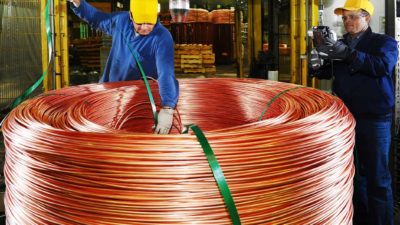
Image source: Getty Images
Copper enters the spotlight
Firstly, mining titan Anglo American plc (LON: AAL) unveiled plans to merge with Canadian counterpart Teck Resources Ltd Class B (NYSE: TECK) in an A$85 billion deal.
This tie-up is set to create the world's fifth-largest copper producer.
And just last week, Freeport-McMoran Inc (NYSE: FCX) announced that mining at its globally significant Grasberg mine in Indonesia is set to remain on hold following a tragic mudslide.
Freeport noted that the mine closure will see its copper output fall by 4% in the third quarter of 2025.
It added that its Indonesian production could be 35% lower in 2026 when compared with pre-incident forecasts.
In turn, the price of copper traded on the London Metals Exchange (LME) spiked on Thursday.
It surpassed US$10,300 per tonne to reach its highest level so far this year.
But this could be just the beginning, according to renowned investment bank Morgan Stanley (NYSE: MS).
The broker believes that the copper price could storm higher throughout the rest of the year and into 2026.
And here's the thing.
Mining giant BHP Group Ltd (ASX: BHP) has been ramping up its copper exposure in the past few years to become today's largest copper producer.
So, a favourable copper pricing environment could be welcome news for BHP shares.
Morgan Stanley's viewpoint
Morgan Stanley appears optimistic about the near-term copper price after factoring in Freeport's production setback, as reported in the Financial Review.
It expects supply of the metal to dip in 2025 and 2026, adding that inventory levels outside the US also remain low.
The broker cited several other factors that suggest a positive setting for copper prices.
These include a weakening US dollar, a Federal Reserve more tolerant of inflation, and hopes of further economic stimulus in China.
Overall, Morgan Stanley believes the LME copper price could reach US$13,775 per tonne by Christmas, and as high as US$14,064 per tonne by the end of 2026.
This implies about 37% upside potential for the copper price by the conclusion of next year.
What could this mean for BHP shares?
In a nutshell, a sharp rise in the copper price could potentially be a boon for BHP shares.
In the past few years, the company has sealed a series of copper deals headlined by its A$10 billion acquisition of South Australian miner Oz Minerals.
It also invested A$3.2 billion to acquire Canadian group Filo Corp and its flagship Argentinian project through a joint venture with Lundin Mining Corp (TSE: LUN).
These deals add to BHP's extensive portfolio of copper mines across Chile, Peru, South Australia, and Arizona.
BHP now claims to be the world's largest copper miner, having grown its output of the metal by 28% over the past three years.
It produced a record 2 million tonnes of copper in FY25, with the metal accounting for 45% of its underlying operating earnings (EBITDA).
Looking ahead, management noted that copper fundamentals remain attractive.
In essence, BHP expects global copper demand to grow from about 33 million tonnes today to more than 50 million tonnes by 2050.
However, it believes copper prices need to increase from the levels seen in the second half of FY25 for future supply to be incentivised.