
This article was originally published on Fool.com. All figures quoted in US dollars unless otherwise stated.
The "Magnificent Seven" is a popular tag for the most dominant, high-performing tech companies on the planet.
Alphabet (NASDAQ: GOOGL), (NASDAQ: GOOG), Amazon, Apple, Meta Platforms, Microsoft, Nvidia, and Tesla have delivered market-crushing returns over the past decade, in large part because their businesses are on the forefront of the most disruptive technology macrotrends in modern history.
While all seven companies are juggernauts in their own right, one Magnificent Seven stock stands out due to its dominant core business, exposure to multiple megatrends, and attractive valuation relative to its cohorts.
That stock is Alphabet.
An unconventional company
There's something else that makes Alphabet different. Unlike the other members of the Magnificent Seven, Alphabet trades under two tickers: GOOG and GOOGL.
Why would Alphabet do that? A little history will provide some helpful context.
Larry Page and Sergey Brin founded Google (Alphabet's predecessor) in 1998. When Google filed its IPO paperwork in 2004, Page declared in a letter to prospective shareholders: "Google is not a conventional company. We do not intend to become one."
In that same letter, Page fretted that becoming a public company could undermine the independence and creative spirit that had been critical to Google's success. He also made it clear that the company would not "shy away from high-risk, high-reward projects" just to hit some arbitrary quarterly financial target.
To ensure that Page, Brin, and the rest of the executive team would retain "control over the company's decisions and fate," Google implemented a dual-class stock structure.
It's all about insider control
Common stock represents partial ownership in a company, and it usually comes with the right to vote on issues such as executive compensation, board members, and mergers and acquisitions. When Google debuted as a publicly traded company in August 2004, it used the dual class structure to concentrate 99% of the voting power in the hands of its founders, executives, and board members. Here's how:
- Each share of Class A common stock (available to regular investors) came with one vote.
- Each share of Class B common stock (held by founders and insiders) came with 10 votes.
At the time, Page acknowledged that this was an unconventional move for a tech company, although it wasn't uncommon for other types of businesses. Perhaps the most well-known example is Berkshire Hathaway. However, in the years since Google's 2004 IPO, a number of tech companies have adopted dual class structures to maintain insider control, including Meta Platforms, Palantir, and Roblox. .
This is where it gets a little confusing
In April 2014, Google added another layer of complexity to its share structure by way of a 2-for-1 stock split.
On April 2, 2014, Google's shareholders received one share of newly issued Class C stock for every share of Class A stock that they already owned.
Starting on April 3, 2014, two classes of Google stock were available to the public:
- Class A shares (GOOGL): One vote per share
- Class C shares (GOOG): No voting power
The important thing to note is the Class C shares don't come with voting rights. That was the whole point of the 2014 stock split. By issuing nonvoting Class C shares, Google could fund acquisitions and offer stock-based compensation and incentives without diluting executives' voting power.
To recap, this is the share structure that exists today:
- Class A shares (GOOGL): One vote per share
- Class B shares (held by insiders): 10 votes per share
- Class C shares (GOOG): No voting power
Should you buy GOOG or GOOGL?
Today, Google the search engine is just one piece of Alphabet, the umbrella company formed in 2015. What makes Alphabet such a compelling investment is that it's not just a search-engine provider. Owning Alphabet is a bit like owning an ETF with exposure to some of the biggest themes in tech -- from cloud computing and AI to autonomous vehicles, cybersecurity, and streaming. And as I alluded to earlier, Alphabet trades at a discount to its Magnificent Seven cohorts based on its forward price-to-earnings (P/E) ratio:
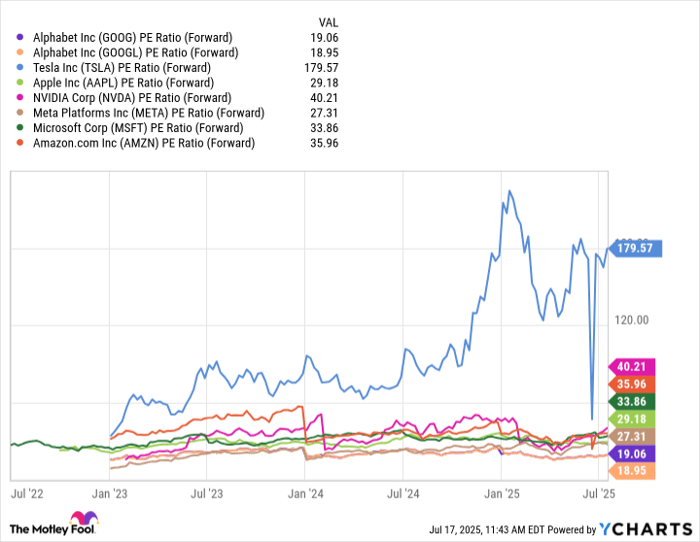
GOOG PE Ratio (Forward) data by YCharts
But there's still one question left to answer: Is GOOG or GOOGL the better investment?
Because GOOGL comes with voting rights, you'd think it would trade at a premium to its Class C sibling, GOOG. But interestingly enough, GOOG has outperformed GOOGL since April 3, 2014, ever-so-slightly:
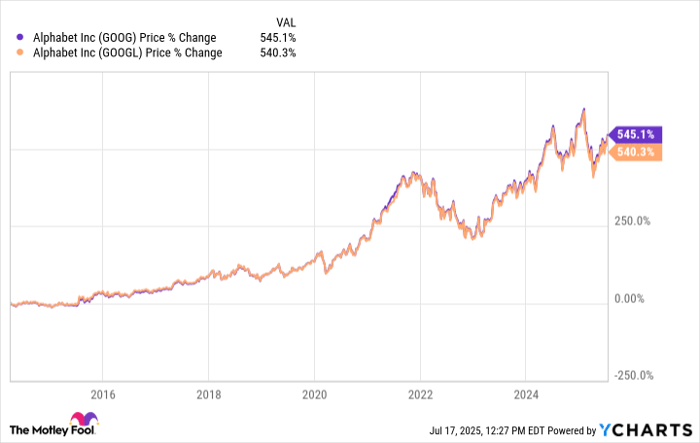
As of July 16, GOOG was priced at $183.77, just a hair above GOOGL at $182.97. So based on the recent price action, you could look at it this way: GOOGL gives you the same exposure to Alphabet's basket of businesses, but at a slightly lower price, with the added benefit of voting power.
In reality, most regular investors can't purchase enough shares to have any meaningful impact on the company's strategic direction through their votes. And because both tickers represent the same underlying security, there likely will never be any wide variation in price between the two. So unless you care deeply about voting rights, either ticker is a great way to invest in this Magnificent Seven standout.
This article was originally published on Fool.com. All figures quoted in US dollars unless otherwise stated.