The BetaShares Global Defence ETF (ARMR) is up 19% this year. Are defence stocks the new safe haven?

Defence stocks could be the new gold.

| More on:

You’re reading a free article with opinions that may differ from The Motley Fool’s Premium Investing Services. Become a Motley Fool member today to get instant access to our top analyst recommendations, in-depth research, investing resources, and more. Learn More

As most investors would be painfully aware, it's been a rough start to the 2025 calendar year for the stock market. Yes, the S&P/ASX 200 Index (ASX: XJO) is enjoying a dramatic relief rally today in the wake of US President Trump's tariff capitulation, currently up just over 4.5%. Even so, the index remains down by just over 5.9% year-to-date.

But it's a very different story when it comes to defence stocks, namely the BetaShares Global Defence ETF (ASX: ARMR), which has had a very strong start to 2025. This exchange-traded fund (ETF) began the year at a price of $17.04 a unit. But today, those same units are worth $20.35 each at the time of writing. That's up a rosy 6.1% today thus far and up a whopping 19.5% or so since the start of January.

Defence stocks seem to be one of the best places to hide from the extreme volatility that has dominated 2025 to date. To illustrate, other traditional safe-haven sectors have not fared nearly as well.

For example, healthcare stocks have seen heavy losses this year, with the S&P/ASX 200 Health Care Index (ASX: XHJ) down 11.65% year to date. 

Consumer staples stocks have held up better. But the S&P/ASX 200 Consumer Staples Index (ASX: XSJ) is still only up by around 2.74% over the same period.

So, could defence stocks be the new safe haven in this uncertain world?
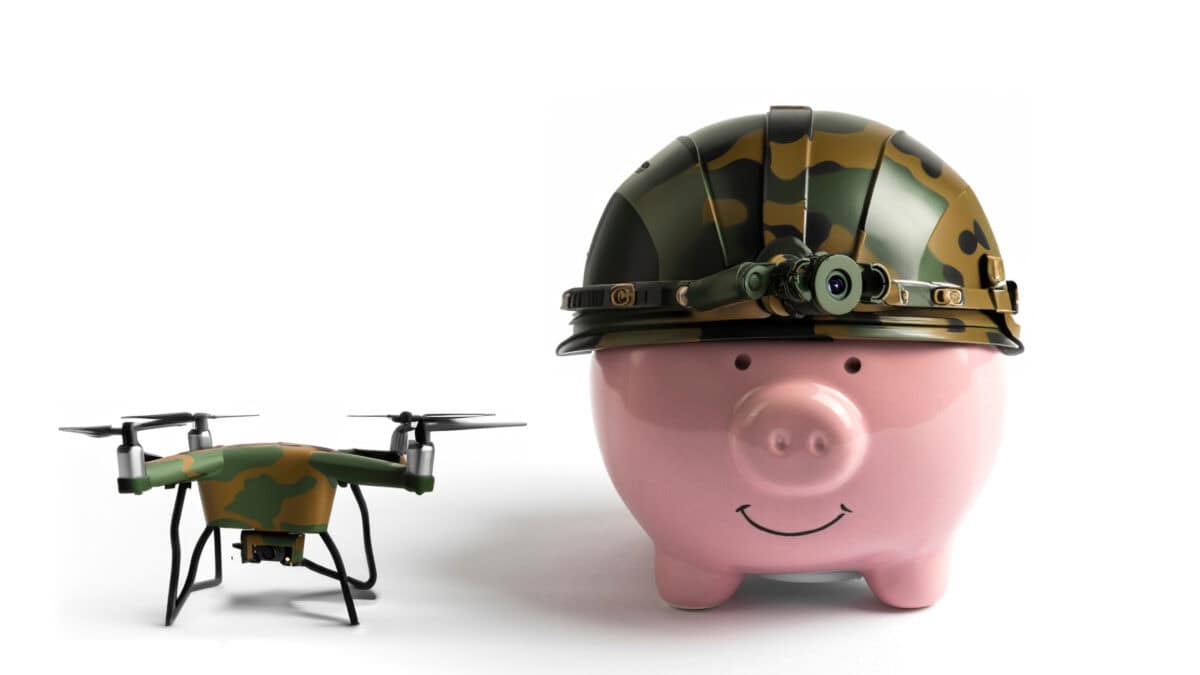
Piggybank with an army helmet and a drone next to it, symbolising a rising DroneShield share price.

Image source: Getty Images

Are defence stocks the new ASX safe haven?

Well, there's a strong argument that they can be. The ARMR ETF is a fund that holds a range of different defence stocks, sourced from all around the world. Its holdings hail from countries as diverse as France, Germany, Norway, South Korea, and Israel. However, more than 60% of its holdings are currently domiciled in the United States.

ARMR's top positions include Rheinmetall, Palantir Technologies, Raytheon Technologies, and Lockheed Martin. All of these companies derive a significant portion of their revenues and earnings from long-term government defence contracts.

This is why investors view defence stocks as a safe haven. Government military spending is one of the most 'untouchable' areas of the typical budget. Most countries, including the United States and Australia, are committed to a slow but steady ramp-up of government spending on the military over the next decade.

This spending is immune to recessions, inflation, and almost every other kind of economic malady. It's arguably one of the last areas of government spending that voters like to see cut.

Additionally, as we discussed last month, the Trump Administration is pressuring many of its allies across Europe and Asia to increase their defence spending going forward.

If this does occur (which is arguably likely given the current geopolitical environment), the companies in ARMR's portfolio will be direct beneficiaries.

So, if you're an investor who likes to buy assets that offer stability and predictable cash flows, this ASX ETF might be an investment you should consider today.

Motley Fool contributor Sebastian Bowen has no position in any of the stocks mentioned. The Motley Fool Australia's parent company Motley Fool Holdings Inc. has positions in and has recommended Palantir Technologies. The Motley Fool Australia's parent company Motley Fool Holdings Inc. has recommended Lockheed Martin and Rheinmetall Ag. The Motley Fool Australia has no position in any of the stocks mentioned. The Motley Fool has a disclosure policy. This article contains general investment advice only (under AFSL 400691). Authorised by Scott Phillips.

More on Defensive Shares

A woman crosses her hands in front of her body in a defensive stance indicating a trading halt.
Defensive Shares

If I had to build a defensive ASX share portfolio today, I'd start here

Defensive investing doesn’t mean giving up long-term potential.

Read more »

Buy and sell written on a white cube.
Defensive Shares

Why it's a great time to buy these ASX 200 shares in these rocky times

These businesses offer investors a mixture of stability and strength.

Read more »

A man in a supermarket strikes an unlikely pose while pushing a trolley, lifting both legs sideways off the ground and looking mildly rattled with a wide-mouthed expression.
Defensive Shares

Woolworths shares recover 22% from all-time low: Buy, sell or hold?

Here's what I'd do with the supermarket's shares.

Read more »

Concept image of man holding up a falling arrow with a shield.
Defensive Shares

Is this the right time to invest in ASX defensive shares?

Should investors be looking towards ASX defensive shares as buys?

Read more »

A small child in a judo outfit with a green belt strikes a martial arts pose with his hand thrust forward.
Defensive Shares

Australian defensive stocks to buy now for stability

With global uncertainty still high, here are three defensive ASX stocks that could potentially help protect your portfolio in 2026.

Read more »

Woman with a scared look has hands on her face.
Defensive Shares

3 ASX 200 shares I'd trust if I couldn't check my portfolio for a year

If I had to step away from my portfolio for a year, I’d focus on businesses with predictable demand and…

Read more »

A smartly-dressed businesswoman walks outside while making a trade on her mobile phone.
Defensive Shares

5 reasons to hold Telstra shares until 2030

Telstra isn’t exciting, but for income and resilience, that may be exactly the point.

Read more »

A person holds their hands over three piggy banks, protecting and shielding their money and investments.
Defensive Shares

Expecting a down year for the ASX? Here's 3 ASX defensive shares to target

How could emerging global conflict impact the ASX?

Read more »