This article was originally published on Fool.com. All figures quoted in US dollars unless otherwise stated.
The S&P 500 (SP: .INX) has experienced a strong recovery since the index hit a relative low in October 2022. Over the past 27 months, the benchmark stock index has soared roughly 69% higher. Yet, many investors have likely seen their personal portfolios fall short of that benchmark due to a phenomenon unseen in more than 40 years.
In 2024, just 28% of stocks in the S&P 500 outperformed the overall index. That's the second-lowest reading available dating back to 1980. The only year where fewer components outperformed the index was 2023, when 27% did better than the index's return.
With just a handful of stocks doing better than the S&P 500, investors who haven't owned the biggest and best-performing stocks over the last 27 months have fallen behind. The S&P 500 is now more concentrated among the top 10 constituents than ever before in history. And if the past is any indication of what to expect, it could signal a big move in the stock market in 2025.
Here's what history says happens next
When only a small minority of stocks outperform the S&P 500 index, it's a clear sign of growing market concentration. The last time we saw back-to-back years where the market saw just a few stocks drive returns for the entire index was in 1998 and 1999.
A couple of notable things happened in the years following.
First, as many investors know, the index peaked in early 2000. The dot-com bubble popped, and high-flying tech stocks were hit hard. The S&P 500's value was cut in half by October 2002, while the Nasdaq Composite Index (NASDAQ: .IXIC) dropped 78% from peak to trough. The growing market concentration and high valuations of the biggest companies in the market are two big reasons why analysts have muted expectations for the future returns of the S&P 500 over the next decade.
But the other notable factor could provide a valuable insight for investors. Many stocks in the S&P 500 actually held up better than the overall index. Over 60% of the constituents in the S&P 500 did better than the index in 2000, 2001, and 2002, and a majority continued to outperform through 2005. In other words, the trend reversed, and the market broadened out.
Will the trend reverse in 2025?
It's impossible to say when the market will broaden out or if we'll see a downturn in the market over the next few years. However, there are some signs that the trend could reverse in 2025 beyond the fact that the market has reached record levels of concentration.
U.S. money supply is growing at an accelerating rate. As the Federal Reserve continues to bring down interest rates, we should see more stable money supply growth, which is a strong predictor of the market broadening. It makes sense economically, as easier access to cash makes it easier for smaller companies to invest and grow. The biggest companies have a massive advantage right now because they have boat loads of cash on hand and can invest in things like artificial intelligence (AI).
That said, the Federal Reserve wants to see more signs of inflation coming down before it continues cutting rates. Trade policies from the new administration have the potential to exacerbate inflation, so we may have to wait and see how actions like tariffs play out.
For long-term investors looking to hedge the significant concentration in the market and the potential trend reversal, there's a simple solution.
The easiest way to put the odds on your side
If you expect the trend to reverse from a small minority of stocks outperforming the S&P 500 to the majority of stocks outperforming, there's a simple exchange-traded fund (ETF) you can buy that will end up performing better than the S&P 500. You can buy an equal-weight S&P 500 index fund like the Invesco S&P 500 Equal Weight ETF.
The equal-weight S&P 500 index buys an equal amount of every constituent in the S&P 500. So, instead of the top five companies accounting for over 27% of the index's value, they account for a combined 1% of the total value — the same as the smallest five companies in the S&P 500. The index rebalances every quarter when the S&P 500 adds and removes new constituents.
Naturally, when the majority of stocks outperform the overall index, the market broadens and the equal-weight index outperforms. That's exactly what happened in 2000 through 2005. While the S&P 500 produced a total return of -6.6% during that period, the equal-weight index produced a total return of 59.2%.
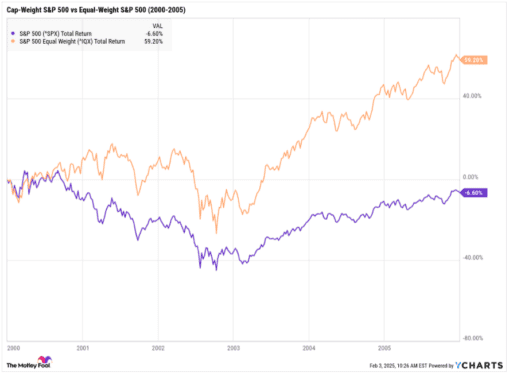
Data by YCharts.
The Invesco index fund is one of the best ways to invest in the equal-weight S&P 500 index. It charges an expense ratio of just 0.2%, and the fund managers have avoided passing on any capital gains to shareholders since its inception, ensuring no tax drag on your investment.
Over the long run, the equal-weight index typically outperforms the capitalisation-weighted index because smaller companies are usually able to grow faster than larger companies. While it hasn't fared well recently, it currently looks like a great opportunity to invest in an ETF tracking the index before the trend reverses.
This article was originally published on Fool.com. All figures quoted in US dollars unless otherwise stated.