This article was originally published on Fool.com. All figures quoted in US dollars unless otherwise stated.
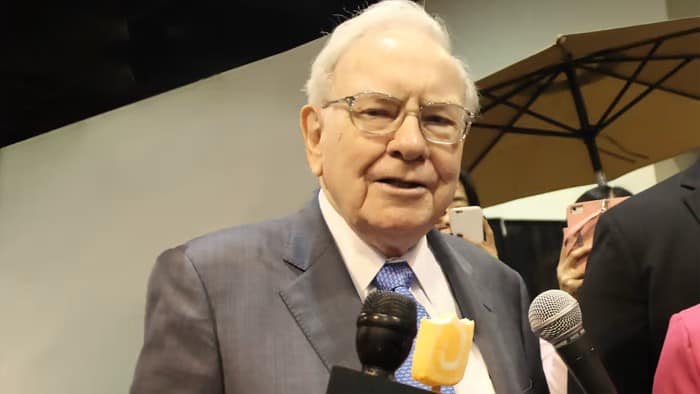
As the CEO of Berkshire Hathaway, Warren Buffett has had a fantastic track record allocating capital. The conglomerate’s stock price has climbed at an impressive 19.8% compound annual rate between 1965 and 2023, substantially outpacing the broader S&P 500 Index (SP: .INX).
Therefore, it’s no wonder the Oracle of Omaha’s investment decisions are closely monitored by the rest of the market -- and recent moves could signal that it might be time to worry. Does billionaire Warren Buffett know something Wall Street doesn’t?
There's one possible warning sign you should be paying close attention to right now.
Building cash
Besides fully owning businesses, Berkshire also runs a massive public equities portfolio. Investors have noticed increased selling activity here. In the first three quarters of 2024, Berkshire sold $133 billion worth of shares in other companies, most notably Apple and Bank of America. This is much higher than the $6 billion of stock that it purchased.
The result is a higher cash position. As of Sept. 30 last year, the Buffett-led company had $325 billion in cash, cash equivalents, and short-term investments on its balance sheet. That was up considerably from the $168 billion at the end of 2023.
Buffett called out the possibility of a higher capital gains tax rate down the line as a key reason for him wanting to take profits off the table. This logic makes sense. But there could be more to the story.
Buffett's warning
Selling a large chunk of stock and watching the cash pile up to a massive level could present a clear warning that Buffett is seriously worried about the stock market's current valuation. Given his unbelievable track record, the average investor might want to take notice.
A widely followed valuation tool is the CAPE ratio. It makes an adjustment to the traditional price-to-earnings ratio by taking inflation into account and by using the average of the previous 10 years’ worth of earnings. The goal is to smooth out bottom-line fluctuations.
It’s worth noting that the CAPE ratio has a high inverse correlation with forward returns. For example, when the CAPE ratio was at 44.2 in November 1999, the S&P 500’s future five-year total annual return was just a negative 10%. And when the CAPE was lower at 13.3 in January 2009, investors benefited from a wonderful 128% forward five-year total return.
As of this writing, the CAPE ratio is at 37.9. It has rarely been higher. Since the time the CAPE ratio started being measured about 150 years ago, its average is 17.2.
The market’s current valuation is a 120% premium to that level. Buffett and Berkshire could be telling everyone that it’s best to adopt a more cautious approach. Maybe there’s a very real possibility of disappointing stock market performance as we look ahead.
M2 money supply
The soaring valuation of the S&P 500 can instil fear among investors. After all, we now have numerous trillion-dollar enterprises, a group that seems to get larger and more valuable every year.
However, there’s no strict rule that says the CAPE ratio can’t continue going higher or that its elevated status always leads to poor returns. This becomes clearer when you consider the trend with M2 money supply among the four major economies (U.S., Europe, China, and Japan), which has doubled in the past 14 years.
More money in the financial system can promote higher asset prices. We've seen this play out right before our eyes since the end of the Great Recession more than a decade ago. Higher real estate values and the creation of the cryptocurrency industry are two other examples of what a greater money supply can lead to.
What's more, the rising popularity of passive investing, which now controls more assets under management than active strategies, means investors continue to buy stocks regardless of valuation.
I think it’s important to take clues from Warren Buffett, the greatest investor ever. But making accurate predictions is difficult, particularly when market and economic dynamics shift. It's still smart to invest early and often, with a long-term mindset.
This article was originally published on Fool.com. All figures quoted in US dollars unless otherwise stated.