This Warren Buffett metric is at a never-before-seen high! What does it mean?

Warren Buffett's valuation indicator could be sending a warning.

Woman and man calculating a dividend yield.

Image source: Getty Images

You’re reading a free article with opinions that may differ from The Motley Fool’s Premium Investing Services. Become a Motley Fool member today to get instant access to our top analyst recommendations, in-depth research, investing resources, and more. Learn More

The S&P 500 Index (SP: .INX) and Nasdaq Composite Index (NASDAQ: .IXIC) reached new all-time highs on Wall Street last night. It should be a cause for celebration. If only the record weren't accompanied by a more sinister number cracking into uncharted territory, too.

Warren Buffett and I both know investing is for the long term, and history has shown that more record highs follow record highs (eventually). And yet, the greatest of all time (GOAT) investor still takes heed of a market consumed by greed.

As it turns out, Warren's own indicator of an overvalued market also reached an all-time high overnight.

Warren Buffett's valuation ratio

Roughly 23 years ago, Warren Buffett explained what he considered to be "the best single measure" of valuations, whether overvalued or undervalued. While the world's tenth richest person has since walked back the importance of the measure, it remains a popular tool among investors.

The metric, aptly known as the 'Buffett Indicator', measures the total market capitalisation of US stocks divided by the country's gross domestic product (GDP). Essentially, it's a ratio of the valuation investors are willing to ascribe to public companies versus the actual size of the country's economy.

Source: The Buffett Indicator: Market Cap to GDP, Longtermtrends

As shown in the chart above, the Warren Buffett Indicator is at a historical high of 195%. Before this rally, the previous high was 194.8%, set in November 2021. The S&P 500 began falling a month later, resulting in a 25% crash over the following nine months.

Why is it at the highest point in its history?

There is a dichotomy between the economy and the stock market, especially in the United States.

On the one hand, the United States economy is softening as interest rates eat into spending. At the same time, there's a seemingly insatiable demand for all things artificial intelligence (AI).
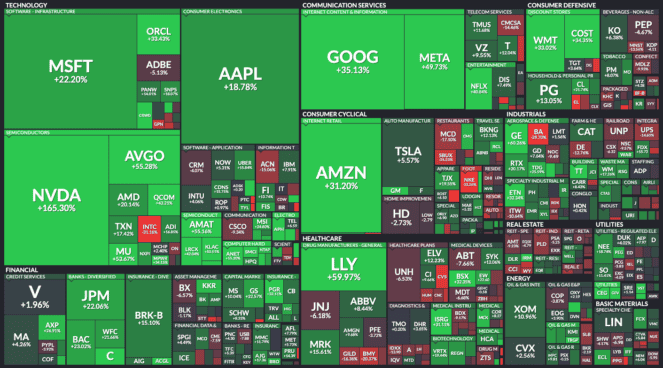
Source: S&P 500 year-to-date performance map, Finviz

As a result, stock market indices are being pushed higher by a small handful of beneficiaries of the AI appetite — Nvidia Corp (NASDAQ: NVDA), Microsoft Corp (NASDAQ: MSFT), etc. These same companies constitute a large portion of the entire US stock market, as shown above.

The narrow concentration of growth could explain the record disconnect between the overall stock market and the United States economy.

What does it mean for investors?

As a strong critic of 'timing the market,' Warren Buffett doesn't dump his portfolio when the overall market looks frothy. Rather, he usually moves incoming cash from his investments in Berkshire Hathaway Inc. (NYSE: BRK) into U.S. Treasury Bills until he discovers an opportunity.

An 'overvalued' market hasn't stopped the Oracle from Omaha from finding stocks to buy. Filings show Buffett bought more shares in oil and gas giant Occidental Petroleum Corp (NYSE: OXY) last month. A company whose shares are only up 1.6% year-to-date.

It shows that the 'market' can be 'expensive', but a good investor can keep hunting. Instead of falling victim to FOMO (fear of missing out), Warren Buffett is zigging when others are zagging.


Motley Fool contributor Mitchell Lawler has no position in any of the stocks mentioned. The Motley Fool Australia's parent company Motley Fool Holdings Inc. has positions in and has recommended Microsoft and Nvidia. The Motley Fool Australia's parent company Motley Fool Holdings Inc. has recommended Occidental Petroleum and has recommended the following options: long January 2026 $395 calls on Microsoft and short January 2026 $405 calls on Microsoft. The Motley Fool Australia has recommended Microsoft and Nvidia. The Motley Fool has a disclosure policy. This article contains general investment advice only (under AFSL 400691). Authorised by Scott Phillips.

More on How to invest

A woman sits in a quiet home nook with her laptop computer and a notepad and pen on the table next to her as she smiles at information on the screen.
How to invest

How to build a $100,000 ASX share portfolio starting at zero

Want to build a big portfolio? Here's the easiest way to do it.

Read more »

A man holding a sign which says How do I start?, indicating a beginner investor on the ASX
How to invest

Start buying shares in December with a spare $500? Here's how!

The best time to start investing is right now.

Read more »

Suncorp share price Businessman cheering and smiling on smartphone
How to invest

How to invest your first $1,000 in the share market the smart way

My first investment would look something like this if I were starting again.

Read more »

Beautiful young couple enjoying in shopping, symbolising passive income.
How to invest

The smart way to make a $25,000 passive income from ASX shares

This could be the smart way to make your money work for you.

Read more »

Happy young couple saving money in piggy bank.
How to invest

$20,000 in savings? Here's how you can use that to target an $8,000 yearly second income

Having $20,000 saved is more powerful than most people realise. Not because $20,000 can produce an income today, but because…

Read more »

A smiling woman with a handful of $100 notes, indicating strong dividend payments
How to invest

How to turn $50 a week into a six-figure ASX share portfolio

Small investments could grow into big wealth with this strategy.

Read more »

Excited couple celebrating success while looking at smartphone.
How to invest

Why today's cheap ASX shares could double my money during the next bull market

These shares could be the ones to buy if you are looking for undervalued options.

Read more »

A businessman compares the growth trajectory of property versus shares.
How to invest

The 10-year wealth plan: how to turn small savings into life-changing results

Building wealth doesn't need to be hard. Here's a simple plan you can follow.

Read more »